
How Jonathan Edwards View Of
"Owning The Covenant"
Relates to
the
Heresy of
Decisional Regeneration
The practice of "Owning The Covenant" began when Puritan church leaders agreed to the Half-way Covenant. "Owning the christian covenant, their owning God the Father, Son, and Holy Ghost to be their God; and by their visibly joining in the public prayers and singing God's praises, there is a show and implicit profession of supreme respect to God and love to him; by joining in the public confessions, they make a show of repentance; by keeping Sabbaths and hearing the word, they make a show of a spirit of obedience; by offering to come to sacraments, they make a show of love to Christ and a dependence on his sacrifice.
To this I answer; It is a great mistake, if any one imagines, that all these external performances are of the nature of a profession, of any thing that belongs to saving grace". Jonathan Edwards wrote: Note: the word "gracious" means "by special grace" as distinguished from "common grace". Theologians always distinguish a profession that is not "gracious" from a profession that comes from a heart that has been changed by supernatural regeneration and indwelling of the Holy Spirit. THE DEFINING FEATURE of evangelical salvation as apposed to state church salvation is Evangelical salvation is by supernatural regeneration while State church salvation is assured if a person is baptized (including as a baby), goes through a course of catechism, and prays a covenant prayer. Jonathan Edwards rejected the idea that "owning the covenant" was any better than completing a program of church catechism followed by a covenant prayer. Note: Jonathan Edwards will continuously use expressions like "gracious dispositions" and "piety of heart". The reader needs to know these phrases refer to a supernaturally "regenerated heart" by "saving grace". The fundamental problem with the practice of "Owning The Covenant" was it was used to allow unregenerate persons to baptize their babies. Section 1: None ought to be admitted as members of the visible church of Christ but visible and professing saints None ought to be admitted as members of the visible church of Christ but visible and professing saints. 2 Thess 1:10. "When he shall come to be glorified in his saints, and admitted in all them that believe." So Rev 5:8; 8:4; 11:18; 13:10; 14:12; 19:8. In other places the word is used so as to have respect not only to real saints, but to such as were saints in visibility, appearance, and profession; and so were outwardly, as to what concerns their acceptance among men nd their outward treatment and privileges, of the company of saints. So the word is used in very many places, which it is needless to mention, as every one acknowledges it. Note: Strongs 230, alethos; truly: KJV - indeed, surely, of a surety, truly, of a (in) truth, verily, very. By these things, and many others which might be observed, it appears, that the distinction of real and visible or professing saints is scriptural, and that the visible church was made up of these two, and that none are according to Scripture admitted into the visible church of Christ, but those who are visible and professing saints or Christians. And it is the more needless to insist longer upon it, because it is not a thing in controversy; so far as my small reading will inform me, it is owned by all protestants. Note: Edwards now deals with Solomon Stoddards' view of the Lord's Supper as a "converting ordinance", that is, a sacrament intended to help church members prepare for regeneration. Stoddard was Edwards' maternal grandfather and the pastor of the Congregational Northridge Church before Edwards. It is indeed ironic that Edwards, the minister that preached the most famous sermon in American history (Sinners In The Hands Of An Angry God), was voted out of his church 10 years later because he insisted that only regenerate persons partake of the Lord's Supper, something ALL Congregational ministers insisted on except for Solomon Stoddard. Solomon Stoddard saw regeneration more as a gradual psychological process than an supernatural event that was definite, complete and identifiable (the evangelical and Edwards' view). Stoddard had a state church view of regeneration as metaphysically accomplished in infant baptism and then evidenced sometime later in the life of the church member. That is why he could consider the Lord's Supper a "converting ordinance", just as every sermon heared and every Scripture read could be a "converting ordinance".The ironic thing was Solomon Stoddard's view of the Lord's Supper as a "converting ordinance" was NOT an Old Light idea. Solomon Stoddard could be seen as the First American Calvinist to promote a psychological view of regeneration as a gradual process until it reached a "tipping point" that would become popular when John Witherspoon brought Scottish Common Sense Realism to America. To be sure, the most eminent diving in New England who has appeared to maintain the Lord's supper to be properly a converting ordinance, was very full in it. In his Appeal to the Learned, in the title-page, and through the Treatise, he supposes that all who come to the Lord's supper, must be visible saints, and sometimes speaks of them as professing saints, page 85, 86: and supposes that it is requisite in order to their being admitted to the communion of the Lord's table, that they make a personal public profession of their faith and repentance to the just satisfaction of the church, page 93, 94. In these things the whole of the position that I would prove is in effect granted. If it be allowed (as it is allowed on all sides) that none ought to be admitted to the communion of the christian visible church, but visible and professing saints of Christians, if these words are used in any propriety of speech, or in any agreement with scripture representations, the whole of that which I have laid down is either implied or will certainly follow. As real saints are the same with real converts, or really gracious persons, so visible saints are the same with visible converts, or those that are visibly converted and gracious persons. Visibility is the same with manifestation or appearance to our view and apprehension. And therefore to be visibly a gracious person, is the same thing as to be a truly gracious person to our view, apprehension, or esteem. The distinction of real and visible does not only take place with regard to saintship or holiness, but with regard to innumerable other things. There is visible and real truth, visible and real honesty, visible and real money, visible and real gold, visible and real diamonds, &c. &c. Visible and real are words that stand related one to another, as the words real and seeming, or true and apparent. Some seem to speak of visibility with regard to saintship or holiness, as though it had no reference to the reality, or as though it were a distinct reality by itself; as though by visible saints were not meant those who to appearance are real saints or disciples indeed, but properly a distinct sort of saints, which is an absurdity. There is a distinction between real money and visible money, because all that is esteemed money and passes for money is not real money, but some is false and counterfeit. By visible money, is not meant that which is taken and passes for a different sort from true money, but that which is esteemed and taken as real money, or which has that appearance that recommends it to men's judgment and acceptance as true money; though men may be deceived, and some of it may finally prove not to be so. There are not properly two sorts of saints spoken of in Scripture. Though the word saints may be said indeed to be used two ways in Scripture, or used so as to reach two sorts of persons; yet the word has not properly two significations in the New Testament, any more than the word gold has two significations among us: the word gold among us is so used as to extend to several sorts of substances; it is true, it extends to true gold, and also to that which only appears to be gold, and is reputed such, and by that appearance or visibility some things that are not real obtain the name of gold; but this is not properly through a diversity in the signification of the word, but by a diversity of the application of it, through the imperfection of our discerning. It does not follow that there are properly two sorts of saints, because some who are not real saints, do by the show and appearance they make obtain the name of saints, and are reputed such, and whom by the rules of Scripture (which are accommodated to our imperfect state) we are directed to receive and treat as saints; any more than it follows that there are two sorts of honest men, because some who are not truly honest men, yet being so seemingly or visibly, do obtain the name of honest men, and ought to be treated by us as such. So there are not properly two distinct churches of Christ, on the real, and another the visible; though they that are visibly or seemingly of the one only church of Christ, are many more than they who are really of his church; and so the visible or seeming church is of larger extent than the real. There is no more visibility of holiness in the brightest professor to the eye of our bodies, without the exercise of the reason and judgment of our minds, than may be in a machine. But nothing short of an apparent probability, or a probable exhibition, can amount to a visibility to the eye of man's reason or judgment. The eye which God has given to man is the eye of reason: and the eye of a Christian is reason sanctified, regulated, and enlightened, by a principle of christian love. Mr. Stoddard, in his Appeal to the Learned, seems to express the very same notion of visibility, and that visibility of saintship which is requisite to persons coming to the Lord's supper, that I have here expressed. In page 10, he makes a distinction between being visibly circumcised in heart, and being really so; evidently meaning by the latter, saving conversion; and he allows the former, viz. a visibility of heart-circumcision, to be necessary to a coming to the Lord's supper. So that according to him, it is not a visibility of moral sincerity only, but a visibility of circumcision of heart, or saving conversion, that is a necessary requisite to a person's coming to the Lord's table. Note: To the reader unaccustomed to pre-nineteenth century theology, "circumcised in the heart" means "supernaturally regenerated". "Visibly circumcised in heart" would mean "visible evidence of supernatural regenertion". And in what manner this must be visible, he signifies elsewhere, when he allows, that it must be so to a judgment of charity; a judgment of rational charity. This he expressly allows over and over; as in page 2, 3, 28, 33, 73, and 95: and having reason to look upon them as such, page 28. And towards the close of his book, he declares himself stedfastly of the mind, that it is requisite those be not admitted to the Lord's supper, who do not make a personal and public profession of their faith and repentance, to the just satisfaction of the church, page 93, 94. Note: "Visibly circumcised in heart" and making "a personal and public profession of their faith and repentance" are two different things. Only God can circumcise the heart, but anyone can make a profession of faith and repentance, which also called "Owning the Covenant". But how he reconciled these passages with the rest of his Treatise, I would modestly say, I must confess myself at a loss. And particularly, I cannot see how they consist with what this venerable and ever-honoured author says, page 16, in these words; "Indeed by the rule that God has given for admissions, if it be carefully attended, more unconverted persons will be admitted than converted." I would humbly inquire, how those visible qualifications can be the ground of a rational judgment, that a person is circumcised in heart, which nevertheless, at the same time, we are sensible are so far from being any probable signs of it, that they are more frequently without it than with it. The appearance of that thing surely cannot imply an appearing probability of another thing, which at the same time we are sensible is most frequently, and so most probably, without that other thing.
Indeed I can easily see, how that may seem visible, and appear probable, to God's people, by reason of the imperfect and dark state they are in, and so may oblige their charity, which yet is not real, and which would not appear at all probable to angels, who stand in a clearer light. And the different degrees of light, in which God's church stands, in different ages, may make a difference in this respect. If it be said, that although persons do not profess that wherein sanctifying grace consists, yet seeing 1) they profess to believe the doctrines of the gospel, which God is wont to make use of in order to sanctification, and are called the doctrine which is according to godliness; and since 2) we see nothing in their lives to make us determine, that they have not had a proper effect on their hearts, 3) we are obliged in charity to hope, that they are real saints, or gracious persons, and to treat them accordingly, and so to receive them into the christian church, and to its special ordinances. I answer, this objection does in effect suppose and grant the very thing mainly in dispute. For it supposes, that a gracious character is the thing that ought to be aimed at in admitting persons into the communion of the church; and so that it is needful to have this charity for persons, or such a favourable notion of them, in order to our receiving them as properly qualified members of the society, and properly qualified subjects of the special privileges to which they are admitted. Whereas, the doctrine taught is, that sanctifying grace is not a necessary qualification, and that there is no need that the person himself, or any other, should imagine he is a person so qualified. The assigned reason is, because it is no qualification requisite in itself; the ordinance of the Lord's supper is as proper for them that are not qualified as for those that are; it being according to the design of the institution a converting ordinance, and so an ordinance as much intended for the good of the unconverted, as of the converted; even as it is with the preaching of the gospel. Note: Edwards boils down the only criterion for Solomon Stoddard's admission to the Lord's Supper. Some sort of belief, that Jesus is the Messiah, is a qualification properly requisite to a coming to the Lord's supper; and therefore it is necessary that we should have a charitable hope, that those have such a belief whom we admit; though it be not necessary that we should know it, it being what none can know of another. But as to grace or christian piety, it clearly follows, on the principles which I oppose, that no kind of visibility or appearance, whether direct or indirect, whether to a greater or less degree, no charity or hope of it, have any thing at all to do in the affair of admission to the Lord's supper; for, according to them, it is properly a converting ordinance. What has any visibility or hope of a person being already in health to do, in admitting him into an hospital for the use of those means that are appointed for the healing of the sick, and bringing them to health? And therefore it is needless here to dispute about the nature of visibility; and all arguing concerning a profession of christian doctrines, and an orderly life being a sufficient ground of public charity, and an obligation on the church to treat them as saints, are wholly impertinent and nothing to the purpose. For on the principles which I oppose, there is no need of any ground for treating them as saints, in order to admitting them to the Lord's supper, the very design of which is to make them saints, any more than there is need of some ground of treating a sick man as being a man in health, in order to admitting him into an hospital. Persons, by the doctrine that I oppose, are not taught to offer themselves as candidates for church communion under any such notion, or with any such pretence, as their being gracious persons; and therefore surely when those that teach them, receive them to the ordinance, they do not receive them under any such notion, nor has any appearance, hope, or thought of it, any thing to do in the case. Note "Piety of heart" means "supernaturally regenerated". But they who are admitted to the Lord's supper, proceeding on the principles of those who hold it to be a converting ordinance, do in no respect profess christian piety, neither in whole nor in part, neither explicitly nor implicitly, directly nor indirectly; and therefore are not professing Christians, or saints by profession. I mean, though they may be godly persons, yet as they come to the ordinance without professing godliness, they cannot properly be called professing saints. But on the contrary, the public doctrine, principle, and custom in such churches, establishes a diverse use of these words and signs. People are taught, that they may use them all, and not so much as make any pretence to the least degree of sanctifying grace; and this is the established custom. So they are used, and so they are understood. And therefore whatever some of these words and signs may in themselves most properly and naturally import, they entirely cease to be significations of any such thing among people accustomed to understand and use them otherwise; and so cease to be of the nature of a profession of christian piety. Note: because Scottish Coimmon Sense Realism has influenced Evangelical salvation theology, most readers will not understand that "piety" is something only God can produce supernaturally by regeneration of the heart and the indwelling of the Holy Spirit. before the influence of Scottish Common Sense Realism, ALL Evangelical ministers understood that the circumcision of the heart was a supernatural event by the immediate activity of the Holy Spirit. But within 100 years of John Witherspoon bringing Scottish Common Sense Realism to the College of New Jersey (later called Princeton), the BIST system began to replace the BEST system in the Inquiry Room, and in 1914, the Inquiry Room was eliminated altogether. As Edwards said, "neither their publicly saying, that they avouch God the Father, Son, and Holy Ghost, to be their God, and that they give themselves up to him, and promise to obey all his commands are taken for ... any thing belonging to... christian piety. There can be no such thing among such a people, as either an explicit or implicit profession of godliness, by any thing which (by their established doctrine and custom) an unregenerate man may and ought to say and perform, knowing himself to be so. For let the words and actions otherwise signify what they will, yet people have in effect agreed among themselves, that persons who use them need not intend them so, and that others need not understand them so. And hence they cease to be of the nature of any pretension to grace. And surely it is an absurdity to say, that men openly and solemnly profess grace, and yet do not so much as pretend to it. If a certain people should agree, and it should be an established principle among them, that men might and ought to use such and such words to their neighbours, which according to their proper signification were a profession of entire love and devoted friendship towards the man they speak to, and yet not think that he has any love in his heart to him, yea, and know at the same time that he had a reigning enmity against him; and it was known that this was the established principle of the people; would not these words, whatever their proper signification was, entirely cease to be any profession or testimony of friendship to his neighbour? To be sure, there could be no visibility of it to the eye of reason. Thus it is evident, that those who are admitted into the church on the principles that I oppose, are not professing saints, nor visible saints; because that thing which alone is truly saintship, is not what they profess, Note: The BEST system examined penitents for evidence of a supernatural change of heart and the indwelling of the Holy Spirit. As such, it was within the bounds of what Edwards would consider a Biblically sanctioned examination. But the BIST system only required that penitents agree with certain salvation scriptures and see themselves as the subject of those scriptures. To assume regeneration has taken place simply because someone agrees with salvation scriptures is not sanctioned in Scripture. Believing on the Lord Jesus Christ is NOT merely believing facts contained in scripture about the Lord Jesus Christ. Edwards now discusses the spurious argument that "moral sincerity" is all that is necessary for "piety". or pretend, or have any visibility of, to the eye of a christian judgment. Or if they in fact be visible and professing saints, yet they are not admitted as such; no profession of true saintship, nor any manner of visibility of it, has any thing to do in the affair. There is one way to evade these things, which has been taken by some. They plead, Although it be true, that the Scripture represents the members of the visible church of Christ as professors of godliness; and they are abundantly called by the name of saints in Scripture, undoubtedly because they were saints by profession, and in visibility, and the acceptance of others, yet this is not with any reference to saving holiness, but to quite another sort of saintship, viz. moral sincerity; and that this is the real saintship, discipleship, and godliness, which is professed, and visible in them, and with regard to which, as having an appearance of it to the eye of reason, they have the name of saints, disciples, &c. in Scripture. — It must be noted, that in this objection the visibility is supposed to be of real saintship, discipleship, and godliness, but only another sort of real godliness, than that which belongs to those who shall finally be owned by Christ as his people, at the day of judgment. To which I answer, This is a mere evasion; the only one, that ever I saw or heard of; and I think the only one possible. For it is certain, they are not professors of sanctifying grace, or true saintship: the principle proceeded on being, that they need make no pretence to that; nor has any visibility of saving holiness any thing to do in the affair. If then they have any holiness at all, it must be of another sort. And if this evasion fails, all fails, and the whole matter in debate must be given up. Therefore I desire that this matter may be impartially considered and examined to the very bottom; and that it may be thoroughly inquired, whether this distinction of these two sorts of real Christianity, godliness, and holiness, is a distinction of which Christ in his word is the author; or whether it be a human invention of something which the New Testament knows nothing of, devised to serve and maintain an hypotheses. — And here I desire that the following things may be observed: Note: Edwards, like all true evagelicals, does not accept infant baptism as de facto regenertion. He does not accept that church people who were baptized as infants are to be accepted as regenerate just because they "own the covenant". He believes unregenerate persons are foolish virgins and the chaff, not saints. It is manifest by what was observed before, that these words are there used but two ways; and that those of mankind to whom these names are applied, are there distinguished into but two sorts, viz. Those who have really a saving interest in Christ, spiritual conformity and union to him, and those who have a name for it, as having a profession and appearance of it. And this is further evident by various representations, which we there find of the visible church; as in the company of virgins that went forth to meet the bridegroom, we find a distinction of them into but two sorts, viz. The wise that had both lamps and oil; and those who had lamps indeed like the wise virgins, (therein having an external show of the same thing,) but really had no oil; signifying that they had the same profession and outward show of religion, and entertained the same hopes with the wise virgins. So when the visible church is represented by the husbandman's floor, we find a distinction but of two sorts, viz. the wheat and the chaff. And, when the church is compared to the husbandman's field, we find a distinction but of two sorts, the wheat and the tares, which (naturalists observe) appear exactly like the wheat, till it comes to bring forth its fruit; representing, that those who are only visible Christians, have an appearance of the nature of wheat, which shall be gathered into Christ's barn, that is, of the nature of saving grace. 2. It is evident, that those who had the name of disciples in the times of the New Testament, bore the name with reference to a visibility of the same relation to Christ, which they had who should be finally owned as his. This is manifest, John 8:30,31. "As he spake these words, many believed on him. Then said Jesus to those Jews which believed on him, If ye continue in my word, then are ye my disciples indeed." (Compare Luke 14:25,26,27. and John 15:8.) The phrase, disciples indeed, is relative; and has reference to a visibility, pretence, or name, only, to which it is set in opposition; which makes it evident, that those who then bore the name of disciples, had a visibility and pretence of discipleship indeed. For true discipleship is not properly set in opposition to any thing else but a pretence to the same thing, that is not true. Note: The reader can see now just how pernitious Scottish common Sense Realism is that denies the biblical meaning of "sincere" and "true". Witherspoon: “an unregenerate person is said to have no true love to God or his neighbour only because it is not the most dominant love, and only the most dominant love will be accepted as true or sincere”. The phrase, gold indeed, is in opposition to something that has the appearance of that same metal, and not to an appearance of brass. If there were another sort of real discipleship in those days, besides saving discipleship, persons might be Christ's disciples indeed, or truly, (as the word in the original is,) without continuing in his word, and without selling all that they had, and without hating father and mother and their own lives, for his sake. By this it appears, that those who bore the name of disciples in those times were distinguished into but two sorts, disciples in name or visibility, and disciples indeed; and that the visibility and profession of the former was of the discipleship of the latter. 3. The same thing is evident by 1 John 2:19. "They went out from us, because they were not of us: If they had been of us, they would no doubt have continued with us." — The words naturally suggest and imply, that those professing Christians, who at last proved false, did, before they went out, seem to belong to the society of the true saints, or those endued with persevering grace and holiness. They seemed to be of their number, and so were accepted in the judgment of charity. These things manifestly imply, that if the christian Corinthians were what they supposed they were, what they professed to be, and what they were accepted to be, they were some of those saints who at the day of judgment should judge angels and men. Note: "Gracious sincerity" means "sincerity from a regenerate heart and the indwelling of the Holy Spirit". "Saving saintship" means "saintship that is saving" 6. That the visibility was not only of moral sincerity but saving grace, is manifest, because the apostle speaks of visible christians as visible "members of Christ's body, of his flesh, and of his bones, and one spirit with him, and temples of the Holy Ghost," Eph 5:30. and 1 Cor 6:16,19. And the apostle Peter speaks of visible Christians as those who were visibly such righteous persons as should be saved; and that are distinguished from the ungodly, and them that obey not the gospel, who shall perish. 1 Peter 4:16,17,18. "Yet if any man suffer as a Christian, let him not be ashamed, but let him glorify God on this behalf. For the time is come that judgment must begin at the house of God; and if first begin at us," (us Christians, comprehending himself, and those to whom he wrote, and all of that sort,) "what shall the end of them be that obey not the gospel of God? And if the righteous scarcely be saved, where shall the ungodly and sinners appear?" Together with the next chapter, verse 15. "Of whom the whole family in heaven and earth is named." Where the context and continuation of discourse demonstrates, that he is still speaking of the same family or household he had spoken of in the latter part of the preceding chapter. So all visible Christians are spoken of as visibly the children of the church which is in heaven. Gal 4:26. "Jerusalem which is above, is free, which is the mother of us all." The same apostle speaks of visible Christians as being visibly come to the heavenly city, and having joined the glorious company of angels there, and as visibly belonging to the "general assembly and church of the first-born, that are written in heaven, and to the spirits of just men made perfect," Heb 12:22,23. And elsewhere they are spoken of as being visibly of the number of those who have their "names written in the book of life," Rev 3:5; 22:19. They who truly have their names written in the book of life, are God's true saints, that have saving grace: as is evident by Rev 13:8. "And all that dwell on the earth, shall worship him, whose names are not written in the book of life of the Lamb slain from the foundation of the world." And Rev 20:12. "And another book was opened, which was the book of life." Verse 15. "And whosoever was not found written in the book of life, was cast into the lake of fire." We are told in the conclusion of this chapter, how they were disposed of whose names were not written in the book of life; and then the prophet proceeds, in the next chapter, to tell us, how they were disposed whose names were found there written, viz. that they were admitted into the New Jerusalem. Verse 27. "And there shall in no wise enter into it any thing that defileth, neither whatsoever worketh abomination, or maketh a lie; but they which are written in the Lamb's book of life." And yet in the next chapter it is implied, that some who were not truly gracious persons, and some that should finally perish, were visibly of the number of those that had both a part in the New Jerusalem, and also their names written in the book of life. Verse 19. "And if any man shall take away from the words of the book of this prophecy, God shall take away his part out of the book of life, and out of the holy city." 8. That baptism, by which the primitive converts were admitted into the church, was used as an exhibition and token of their being visibly "regenerated, dead to sin, alive to God, having the old man crucified, being delivered from the reigning power of sin, being made free from sin, and become the servants of righteousness, those servants of God that have their fruit unto that holiness whose end is everlasting life;" as is evident by Romans vi. throughout. In the former part of the chapter, he speaks of the Christian Romans, as "dead to sin, being buried with Christ in baptism, having their old man crucified with Christ," &c. He does not mean only, that their baptism laid them under special obligations to these things, and was a mark and token of their engagement to be thus hereafter; but was designed as a mark, token, and exhibition, of their being visibly thus already. As is most manifest by the apostle's prosecution of his argument in the following part of the chapter. Verse 14. "For sin shall not have dominion over you, for ye are not under the law, but under grace." Verse 17, 18. Verse 22. 9. It is evident, that it is not only a visibility of moral sincerity in religion, which is the scripture qualification of admission into the christian church, but a visibility of regeneration and renovation of heart, because it was foretold that God's people and the ministers of his house in the days of the Messiah, should not admit into the christian church any that were not visibly circumcised in heart. Ezek 44:6-9. The venerable author of the Appeal to the Learned, says, page 10. "That this scripture has no particular reference to the Lord's supper." I answer, though I do not suppose it has merely a reference to that ordinance, yet I think it manifest, that it has a reference to admitting persons into the christian church, and to external church privileges. It might be easy to prove, that these nine last chapters of Ezekiel must be a vision and prophecy of the state of things in the church of God in the Messiah's days; but I suppose it will not be denied, it being a thing wherein divines are so generally agreed. And I suppose, none will dispute but that by the house of God and his sanctuary, which it is here foretold the uncircumcised in heart should not be admitted into in the days of the gospel, is meant the same house, sanctuary, or temple of God, that the prophet had just before been speaking of, in the foregoing part of the same chapter, and been describing throughout the four preceding chapters. But we all know, that the New Testament house of God is his church. Heb 3:3. "For this man was counted worthy of more glory than Moses, inasmuch as he who builded the house, hath more honour than the house." Verse 6. "But Christ as a Son over his own house, whose house are we," &c. 2 Tim 2:20. "In a great house there are not only vessels of gold and silver, but also of wood and of earth," &c. 1 Tim 3:15. "That thou mayest know how thou oughtest to behave thyself in the house of God, which is the church of the living God." Eph 2:20,21. "And are built upon the foundation of the prophets and apostles, Jesus Christ himself being the chief corner-stone; in whom all the building fitly framed together, groweth into an holy temple in the Lord." 1 Cor 3:9. "Ye are God's building." Verse 16. "Know ye not, that ye are the temple of God?" 1 Peter 2:5. "Ye also as lively stones are built up a spiritual house." 1 Peter 4:17. Heb 10:21. "And having an high priest over the house of God." Ezekiel's temple is doubtless the same which it is foretold the Messiah should build. Zech 6:12,13. And what the temple that Christ builds is, the apostle tells us, Heb 3:3,6. The temple that Ezekiel in his vision was bid to observe the measures of, as measured with a reed, (Ezek 40:3,4.) we have reason to think, was the same the apostle John in his vision was bid to measure with a reed, Rev 11:1. And when it is here foretold, that the uncircumcised in heart should not enter into the Christian sanctuary or church, nor have communion in the offerings of God's bread, of the fat and blood, that were made there, I think so much is at least implied, that they should not have communion in those ordinances of the christian sanctuary, in which that body and blood of Christ were symbolically represented, which used of old to be symbolically represented by the fat and the blood. For the admission into the christian church here spoken of, is an admission into the visible, and not the mystical, church; for such an admission is spoken of as is made by the officers of the church. And I suppose it will not be doubted, but that by circumcision of heart is meant the spiritual renewing of the heart; not any common virtues, which do not in the least change the nature, and mortify the corruption of the heart; as is held by all orthodox divines, and as Mr. Stoddard in particular abundantly insisted. However, if any body disputes it, I desire that the Scripture may be allowed to speak for itself; for it very often speaks of circumcision of heart, and this every where, both in the Old Testament and New, manifestly signifies that great change of heart that was typified by the ceremony of circumcision of the flesh. The same which afterwards was signified by baptism, viz. regeneration, or else the progress of that work in sanctification; as we read of the washing of regeneration, &c. The apostle tells us what was signified both by circumcision and baptism, Col 2:11,12. "In whom also ye are circumcised with the circumcision made without hands, in putting off the sins of the flesh by the circumcision of Christ, buried with him in baptism; wherein also you are risen with him, through the faith of the operation of God." Where I would observe by the way, he speaks of all the members of the church of Colosse as visibly circumcised with this circumcision; agreeable to Ezekiel's prophecy, that the members of the christian church shall visibly have this circumcision. The apostle speaks, in like manner, of the members of the church of Philippi as spiritually circumcised, (i. e. in profession and visibility,) and tells wherein this circumcision appeared. Phil 3:3. "For we are the circumcision, which worship God in the spirit, and rejoice in Christ Jesus, and have no confidence in the flesh." And in Rom 2:28,29. the apostle speaks of this christian and Jewish circumcision together, calling the former the circumcision of the heart. "But he is not a Jew which is one outwardly, neither is that circumcision which is outward in the flesh; but he is a Jew, which is one inwardly, the circumcision is that of the heart, in the spirit, not in the letter; whose praise is not of men, but of God." And whereas in this prophecy of Ezekiel it is foretold, that none should enter into the christian sanctuary or church, but such as are circumcised in heart and circumcised in flesh; thereby I suppose is intended, that none should be admitted but such as were visibly regenerated, as well as baptized with outward baptism. By what has been observed, I think it abundantly evident, that the saintship, godliness, and holiness, of which, according to Scripture, professing Christians and visible saints do make a profession and have a visibility, is not any religion and virtue that is the result of common grace, or moral sincerity, (as it is called,) but saving grace. — Yet there are many other clear evidences of the same thing, which may in some measure appear in all the following part of this discourse. Note: The following section refers to those who have experienced regeneration and the indwelling of the Holy Spirit. Only for the regenerate is Owning the Covenant a useful outward sign of an inward grace, just like water baptism. Put another way, having unregenerate persons Own the Covenant is as wrong as having unregenerate persons baptized in water. Section 2: All who are capable of it are bound to make an explicit open profession of the true religion All who are capable of it are bound to make an explicit open profession of the true religion. I come to another reason, why I answer the question at first proposed, in the negative, viz. That it is a duty which in an ordinary state of things is required of all that are capable of it, to make an explicit open profession of the true religion, by owning God's covenant; or, in other words, professedly and verbally to unite themselves to God in his covenant, by their own public act. Here I would (first) prove this point; and then (secondly) draw the consequence, and show how this demonstrates the thing in debate. First, I shall endeavour to establish this point, viz. That it is the duty of God's people thus publicly to own the covenant; and that it was not only a duty in Israel of old, but is so in the christian church, and to the end of the world; and that it is a duty required of adult persons before they come to sacraments. And this being a point of great consequence in this controversy, but a matter seldom handled, (though it seems to be generally taken for granted,) I shall be the more particular in the consideration of it. This swearing by the name, or into the name, of the Lord, is so often, and in such a manner, spoken of by the prophets as a great duty of God's solemn public worship, as much as praying or sacrificing, that it would be unreasonable to understand it only, or chiefly, of occasionally taking an oath before a court of judicature, which, it may be, one tenth part of the people never had occasion to do once in their lives. If we well consider the matter, we shall see abundant reason to be satisfied, that the thing intended in this institution was publicly covenanting with God. Covenanting in Scripture is very often called by the name of swearing, and a covenant is called an oath. And particularly God's covenant is called his oath, Deuteronomy 39:12 . "That thou shouldst enter into covenant with the Lord thy God, and into his oath." Verse 14. 1 Chron 16:15,16. "Be ye mindful always of his covenant: — Even of the covenant which he made with Abraham, and his oath unto Isaac." 2 Chron 15:12. "And they entered into covenant to seek the Lord God of their fathers." Verses 14, 15. "And they sware unto the Lord with a loud voice: and all Judah rejoiced at the oath." Swearing to the Lord, or swearing in or into the name of the Lord, are equipollent expressions in the Bible. The prefixed beth and lamed are evidently used indifferently in this case to signify the same thing, Zeph 1:5. "That swear by the Lord, and that swear by Malcham." The word translated to the Lord, is Laihovah, with the prefix lamed; but to Malcham, is Bemalcham with the prefix beth, into Malcham. In 1 Kings 18:32. it is said, "Elijah built an altar in the name of the Lord;" beshem. Here the prefix beth is manifestly of the same force with lamed, in 1 Kings 8:44. "The house I have built for thy name or to thy name;" leshem. These words CHAI JEHOVAH, Jehovah liveth, summarily comprehend a profession of faith in that all-sufficiency and immutability of God, which is implied in the name JEHOVAH, and which attributes are very often signified in Scripture by God's being the living god, as is very manifest from Josh 3:10. 1 Sam 17:26,36. 2 Kings 19:4,16. Dan 6:26. Ps 18:46. and innumerable other places. The other thing professed in swearing into the Lord was obedience, called, Walking in the name of the Lord. Mic 4:5. "All people will walk every one in the name of his god, and we will walk in the name of the Lord our God for ever and ever." Still with the prefix beth, beshem, as they were said to swear beshem, in the name, or into, the name of the Lord. And this was not only an institution belonging to Israel under the Old Testament, but also to Gentile converts, and Christians under the New Testament. Thus God declares concerning the Gentile nations, Jer 12:16. "If they will diligently learn the ways of my people, to swear by my name, the lord liveth, as they taught my people to swear by Baal: then shall they be built in the midst of my people," i.e. They shall be added to my church; or as the apostle Paul expresses it, Eph 2:19-22. "They shall be no more strangers and foreigners, but fellow-citizens with the saints, and of the household of God, and be built upon the foundation of Christ; in whom all the building fitly framed together, &c. — In whom they also shall be builded for an habitation of God through the Spirit." So it is foretold, that the way of public covenanting should be the way of the Gentiles joining themselves to the church in the days of the gospel, Isa 44:3-5. "I will pour water upon him that is thirsty, and floods upon the dry ground; I will pour my Spirit upon thy seed, and my blessing upon thine offspring, and they shall spring up as among the grass, as willows by the water-courses; one shall say, I am the Lord's, and another shall call himself by the name of Jacob, and another shall subscribe with his hand unto the Lord," — as subscribing an instrument whereby they bound themselves to the Lord. This was subscribing and covenanting themselves into the name of Israel, and swearing into the name of the Lord, in the language of those forementioned texts in Deuteronomy. So taking hold of God's covenant, is foretold as the way in which the sons of the stranger in the days of the gospel should be joined to God's church, and brought into God's sanctuary, and to have communion in its worship and ordinances, in Isa 56:3,6,7. So in Isa 19:18. the future conversion of the Gentiles in the days of the gospel, and their being brought to profess the true religion, is expressed by saying, that they should swear to the lord of hosts. "In that day shall five cities in the land of Egypt speaks the language of Canaan, and swear to the Lord of hosts." So in Jer 23:5-8. it seems to be plainly foretold, that after Christ is come, and has wrought out his great redemption, the same way of publicly professing faith in the all-sufficient and immutable God, by swearing, The Lord liveth, should be continued, which was instituted of old; but only with this difference, that whereas formerly they covenanted with God as their Redeemer out of Egypt, now they shall as it were forget that work, and have a special respect to a much greater redemption. "Behold, the days come, saith the Lord, that I will raise unto David a righteous Branch. — Therefore they shall no more say, The Lord liveth, which brought up the children of Israel out of the land of Egypt; but, The Lord liveth, which brought up, and which led the seed of the house of Israel out of the north country," &c. Another remarkable place wherein it is plainly foretold that the like method of professing religion should be continued in the days of the gospel, is Isa 45:22-25."Look unto me, and be ye saved, all ye ends of the earth; for I am God, and there is none else: I have sworn by myself, the word is gone out of my mouth in righteousness, and shall not return, that unto me every knee shall bow, every tongue shall swear: surely shall one say, In the Lord have I righteousness and strength: even to him shall men come: — in the Lord shall all the seed of Israel be justified, and shall glory." This prophecy will have its last fulfilment at the day of judgment; but it is plain, that the thing most directly intended is the conversion of the Gentile world to the christian religion. What is here called swearing, the apostle, in citing this place, once and again calls confessing; Rom 14:11. — "Every tongue shall confess to God." Phil 2:10. — "That every tongue should confess that Jesus Christ is Lord." Which is the word commonly used in the New Testament, to signify making a public profession of religion. So Rom 10:9,10. Where a public profession of religion with the mouth is evidently spoken of as a great duty of all Christ's people, as well as believing in him; and ordinarily requisite to salvation; not that it is necessary in the same manner that faith is, but in like manner as baptism is. Faith and verbal profession are jointly spoken of here as necessary to salvation, in the same manner as faith and baptism are, in Mark 16:16. "He that believeth and is baptized, shall be saved." And I know no good reason why we should not look on moral profession and covenanting with Christ, in those who are capable of it, as much of a stated duty in the christian church, and an institution universally pertaining to the followers of Christ, as baptism. And if explicit, open covenanting with God be a great duty required of all, as has been represented, then it ought to be expected of persons before they are admitted to the privileges of the adult in the church of Christ. Surely it is proper, if this explicit covenanting takes place at all, that it should take place before persons come to those ordinances wherein they, by their own act, publicly confirm and seal this covenant. This public transaction of covenanting, which God has appointed, ought to have existence, before we publicly confirm and seal this transaction. It was that by which the Israelites of old were introduced into the communion of God's nominal or visible church and holy city: as appears by Isa 48:1,2. When, and after what manner particularly, the Israelites ordinarily performed this explicit covenanting, I do not know that we can be certain. But, as it was first done on occasion of God's first promulgating his law or covenant at mount Sinai — on a repetition or renewed promulgation of it on the plains of Moab — on the public reading of the law in Josiah's time (2 Kings 23:3.) — on after the return from the captivity — and on the public reading of it at the feast of tabernacles (Neh 8; 9; 10.) so it appears to me most likely, that it was done every seventh year, when the law or covenant of God was, by divine appointment, read in the audience of all the people at the feast of tabernacles; at least by all who then heard the law read the first time, and who never had publicly owned the covenant of God before. There are good evidences that they never had communion in those ordinance which God had appointed as seals of his covenant, wherein they themselves were to be active, such as their sacrifices, &c. till they had done it. It is plainly implied in Ps 1. that it was the manner in Israel vocally to own God's covenant, or to take it into their mouths, before they sealed that covenant in their sacrifices. See verse 16. taken with the preceding part of the psalm, from verse 5. And that they did it before they partook of the passover, (which indeed was one of their sacrifices,) or entered into the sanctuary for communion in the temple-worship, is confirmed by the words of Hezekiah, when he proclaimed a passover, 2 Chron 30:8. To give the hand, seems to be a Hebrew phrase for entering into covenant, or obliging themselves by covenant, Ezra 10:19. "And they gave their hands that they would put away their wives." And, as has been already observed, it was foretold that Christians should in this way be admitted to communion in the privileges of the church of Christ. — Having thus established the premises of the argument, I now come to the consequence. Note: "Real piety" means "having experienced regeneration and the indwelling of the Holy Spirit". Only for the regenerate is a profession of real piety a useful outward sign of an inward grace, just like water baptism. Put another way, having unregenerate persons make a profession of real piety is as wrong as having unregenerate persons baptized in water. That none ought to be admitted to the privileges of adult persons in the church of Christ, but such as make a profession of real piety. The covenant to be owned or professed, is God's covenant, which he has revealed as the method of our spiritual union with him, and our acceptance as the objects of his eternal favour; which is no other than the covenant of grace; at least it is so, without dispute, in these days of the gospel. To own this covenant, is to profess the consent of our hearts to it; and that is the sum and substance of true piety. It is not only professing the assent of our understandings that we understand there is such a covenant, or that we understand we are obliged to comply with it; but it is to profess the consent of our wills, it is to manifest that we do comply with it. Note: "The consent of our wills" does not mean "I want this" with the mind. The will can only be changed by God when he changes the heart supernaturally. Unregenerate man may will something, but it is impossible for him to will the will of God. The mind is NOT the real person...the heart is the real person. The will of the mind means absolutely nothing. The will of the mind changes with the circumstances of life and the whims of the flesh. The will of the heart is changed only by regeneration. There is mutual profession in this affair, a profession on Christ's part, and a profession on our part; as it is in marriage. And it is the same sort of profession that is made on both sides, in this respect, that each professes a consent of heart. Christ in his word declares an entire consent of heart as to what he offers; and the visible Christian, in the answer that he makes to it in his christian profession, declares a consent and compliance of heart to his proposal. Owning the covenant is professing to make the transaction of that covenant our own. The transaction of that covenant is that of espousals to Christ; on our part, it is giving our souls to Christ as his spouse. There is no one thing that the covenant of grace is so often compared to in Scripture, as the marriage-covenant; and the visible transaction, or mutual profession, there is between Christ and the visible church, is abundantly compared to the mutual profession there is in marriage. In marriage the bride professes to yield to the bridegroom's suit, and to take him for her husband, renouncing all others, and to give up herself to him to be entirely and for ever possessed by him as his wife. But he that professes this towards Christ, professes saving faith. They that openly covenanted with God according to the tenor of the institution, Deut 10:20. visibly united themselves to God in the union of that covenant. They professed on their parts the union of the covenant of God, which was the covenant of grace. It is said in the institution, "Thou shalt cleave to the Lord, and swear by his name;" or as the words more literally are, "Thou shalt unite unto the Lord, and swear into his name." So in Isa 56. it is called a "joining themselves to the Lord." But the union, cleaving, or joining of that covenant, is saving faith, the grand condition or the covenant of Christ, by which we are in Christ. This is what [on our part] brings us into the Lord. For a person explicitly or professedly to enter into the union or relation of the covenant of grace with Christ, is the same as professedly to do that which on our part is the uniting act, and that is the act of faith. To profess the covenant of grace, is to profess it, not as a spectator, but as one immediately concerned in the affair, as a party in the covenant professed; and this is to profess that in the covenant which belongs to us as a party, or to profess our part in the covenant; and that is the soul's believing acceptance of the Saviour. Christ's part is salvation, our part is a saving faith in him; not a feigned, but unfeigned faith; not a common, but special and saving faith; no other faith is the condition of the covenant of grace. Note: Saving faith is the fruit of supernatural regeneration and the indwelling of the Holy Spirit. Common faith is the faith of at least 80% of people who make a decision for Christ in altar calls today. Common faith is not saving faith...it is merely common sense of the unregenerate. I know the distinction made by some, between the internal and external covenant; but, I hope, the divines that make this distinction, would not be understood, that there are really and properly two covenants of grace; but only that those who profess the one only covenant of grace, are of two sorts. There are those who comply with it internally and really, and others who do so only externally, that is, in profession and visibility. But he that externally and visibly complies with the covenant of grace, appears and professes to do so really. — There is also this distinction concerning the covenant of grace; it is exhibited two ways, the one externally, by the preaching of the word, the other internally and spiritually, by enlightening the mind rightly to understand the word. But it is with the covenant, as it is with the call of the gospel: he that really complies with the external call, has the internal call; so he that truly complies with the external proposal of God's covenant, as visible Christians profess to do, does indeed perform the inward condition of it. But the New Testament affords no more foundation for supposing two real and properly distinct covenants of grace, than it does to suppose two sorts of real Christians. Note: Edwards now deals with the "nose of the camel under the tent", that is, infant baptism, which is seen by state churches as metaphysical regeneration, as apposed evangelical, or experiential salvation. Infant baptism was seen by the Puritans that approved the Halfway Covenant and Owning the Covenant as an insurance policy for keeping membership in their churches. It actually served as a wedge to promote nominal Christianity of the state church type the Puritans originally claimed to abhor so much that they came to the New World in order to escape it. Evangelicals like Edwards, Whitefield and all New Light Calvinists that followed, saw "using the means of grace" and "waiting on God for regeneration" as an excuse for not repenting. When those persons who were baptized in infancy properly own their baptismal covenant, the meaning is, that they now, being capable to act for themselves, do professedly and explicitly make their parents' act, in giving them up to God, their own, by expressly giving themselves up to God. But this no person can do, without either being deceived, or dissembling and professing what he himself supposes to be a falsehood, unless he supposes that in his heart he consents to be God's. A child of christian parents never does that for himself which his parents did for him in infancy, till he gives himself wholly to God. But surely he does not do it, who not only keeps back a part, but the chief part, his heart and soul. He that keeps back his heart, does in effect keep back all; and therefore, if he be sensible of it, is guilty of solemn wilful mockery, if at the same time he solemnly and publicly professes that he gives himself up to God. If there are any words used by such, which in their proper signification imply that they give themselves up to God; and if these words, as they intend them to be understood, and as they are understood by those that hear them, according to their established use and custom among that people, do not imply, that they do it really, but do truly reserve or keep back the chief part; it ceases to be a profession of giving themselves up to God, and so ceases to be a professed covenanting with God. The thing which they profess belongs to no existing covenant of God; for God has revealed no such covenant, in which our transacting of it is a giving up ourselves to him with reserve, or holding back our souls, our chief part, and in effect our all. And therefore, although such public and solemn professing may be a very unwarrantable and great abuse of words, and taking God's name in vain, it is no professed covenanting with God. One thing, as observed, that belonged to Israel's swearing into the name of the Lord, was saying, The Lord liveth; whereby they professed their faith in God's all-sufficiency, immutability, and faithfulness. But if they really had such a faith, it was a saving grace. Note: Saving grace (also called special grace) is supernatural regenertion and the indwelling of the Holy Spirit. Common grace is available to all living creatures. Saving grace is supernatural grace given only to saints. Since Scottish Common Sense Realism did not believe in the immediate activity of the Holy Spirit in regeneration, it made no species distinction between common and saving grace. John Witherspoon wrote: “There were … great debates whether special and common grace differ essentially in their nature, or if they differ only in degree… I embrace the last of these opinions”. To them who indeed trust in the all-sufficiency of God, he will surely be an all-sufficient portion; and them who trust in God's immutability and faithfulness, he surely will never leave nor forsake. There were two ways of swearing Jehovah liveth, that we read of in Scripture; one we read of, Jer 2:2. "Thou shalt swear, The Lord liveth, in truth, in judgment, and in righteousness:" and the other way is swearing falsely, which we read of in the next chapter, verse 2, 3. "And though they say, The Lord liveth, yet surely they swear falsely." And certainly none ought to do this. It follows, "O Lord, are not thine eyes upon the truth?" i.e. God desires sincerity of heart in those that profess religion. Here a gracious sincerity is opposed to a false profession; for when it is said, "O Lord, are not thine eyes upon the truth?" the expression is parallel with Ps 51:6. "Behold thou desirest truth in the inward parts." 1 Sam 16:7. "Man looketh on the outward appearance, but the Lord looketh on the heart." Ps 11:7. "His countenance doth behold the upright." But these texts speak of a gracious sincerity. Note: Edwards would have been shocked had he known his beloved College of New Jersey was taken over by John Witherspoon, who wrote, “an unregenerate person is said to have no true love to God or his neighbour only because it is not the most dominant love, and only the most dominant love will be accepted as true or sincere”, and “I cannot help thinking, that for a sinner truly and sincerely to desire a change of nature, would be an evidence of a change begun.” THERE IS NO WAY FOR AN UNREGENERATE PERSON TO BE TRUE OR SINCERE! TRUTH AND SINCERITY ARE DELUSIONS OF THE UNREGENERATE HEART. UNREGENERATE PERSONS ARE TRULY AND SINCERELY WRONG. Those spoken of, Jer 4:2. that "sware, The Lord liveth, in truth, in judgment, and righteousness," were gracious persons, who had a thorough conversion to God, as appears by the preceding verse, "If thou wilt return, O Israel, saith the Lord, return unto me;" i.e. Do not do as Judah was charged with doing in Jer 3:10. "Judah hath not turned unto me with her whole heart, but feignedly." Do not do thus, "but if thou wilt return, return unto me." And then it is added in the second verse, "And thou shalt swear, The Lord liveth, in truth," &c.; that is, then your profession of religion will be worth regarding, you will be indeed what you pretend to be, you will be Israelites indeed, in whose profession is no guile. They who said, "The Lord liveth, in truth, in judgment, and in righteousness;" said, The Lord liveth, as David did, Ps 18:46. "The Lord liveth, and blessed be my Rock." And as the apostle says he did, 1 Tim 4:10. "We trust in the living God, who is the Saviour of all men, especially of those that believe." And as he would have Timothy exhort rich men to do, 1 Tim 6:17. "That they trust not in uncertain riches, but in the living God." When the apostle speaks of a profession of our faith in Christ, as one duty which all Christians ought to perform as they seek salvation, it is the profession of a saving faith. His words plainly imply it: "If thou shalt confess with thy mouth the Lord Jesus, and shalt believe in thine heart that God hath raised him from the dead, thou shalt be saved." The faith which was to be professed with the mouth, was the same which the apostle speaks of as in the heart, but that is saving faith. The latter is yet plainer in the following words; "for with the heart man believeth unto righteousness, and with the mouth confession is made unto salvation." Believing unto righteousness, is saving faith; but it is evidently the same faith which is spoken of, as professed with the mouth, in the next words in the same sentence. And that the Gentiles, in professing the christian religion, or swearing to Christ, should profess saving faith, is implied, Isa 45:23,24. — "Every tongue shall swear; surely shall one say, In the Lord have I righteousness and strength;" i.e. should profess entirely to depend on Christ's righteousness and strength. Note: The heart is the real person. If the heart believes of the Lord Jesus Christ, it is only because the heart has been changed by God supernaturally. For persons merely to promise, that they will believe in Christ, or that they will hereafter comply with the conditions and duties of the covenant of grace, is not to own that covenant. Such persons do not profess now to enter into the covenant of grace with Christ, or into the relation of that covenant to Christ. All they do at present, is to say, they will do it hereafter; they profess, that they will hereafter obey that command of God, to believe on the name of his Son Jesus Christ. But what is such a profession good for, and what credit is to be given to such promises of future obedience; when at the same time they pretend no other at present, than to live and continue in rebellion against those great commands which give no allowance or licence for delay? They who do thus, instead of properly owning the covenant, do rather for the present visibly reject it. It is not unusual, in some churches, where the doctrine I oppose has been established, for persons at the same time that they come into the church, and pretend to own the covenant, freely to declare to their neighbours, they have no imagination that they have any true faith in Christ, or love to him. Such persons, instead of being professedly united to Christ, in the union of the covenant of grace, are rather visibly destitute of the love of Christ; and so, instead of being qualified for admission to the Lord's supper, are rather exposed to that denunciation of the apostle, 1 Cor 16:22. "If any man love not the Lord Jesus Christ, let him be Anathema Maran-atha." That outward covenanting, which is agreeable to scripture-institution, is not only a promising what is future, (though that is not excluded,) but a professing what is present, as it is in the marriage-covenant. For a woman to promise, that she will hereafter renounce all other men for the sake of him who makes suit to her, and will in some future time accept of him for her husband, is not for her now to enter into the marriage-covenant with him. She that does this with a man, professes now to accept of him, renouncing all others; though promises of hereafter behaving towards him as a wife, are also included in the transaction. It seems the primitive converts to Christianity, in the profession they made of religion, in order to their admission into the christian church, and in their visibly entering into covenant, in order to the initiating seal of the covenant in baptism, did not explicitly make any promises of any thing future. Note: Christ warned, "ye have heard that it hath been said by them of old time, Thou shalt not forswear thyself, but shalt perform unto the Lord thine oaths: But I say unto you, Swear not at all; neither by heaven; for it is God's throne: Nor by the earth; for it is his footstool: neither by Jerusalem; for it is the city of the great King. Neither shalt thou swear by thy head, because thou canst not make one hair white or black. But let your communication be, Yea, yea; Nay, nay: for whatsoever is more than these cometh of evil" (Matthew 5:33-37). James warned, " But above all things, my brethren, swear not, neither by heaven, neither by the earth, neither by any other oath: but let your yea be yea; and your nay, nay; lest ye fall into condemnation" (James 5:12). They only professed the present sentiments and habit of their minds, they professed that they believed in Christ, and so were admitted into the church by baptism; and yet undoubtedly they were, according to forementioned prophecies, admitted in the way of public covenanting. As the covenant-people of God, they owned the covenant, before the seal of the covenant was applied. Their professing faith in Christ was visibly owing the covenant of grace, because faith in Christ was the grand condition of that covenant. Indeed, if the faith which they professed in order to baptism, was only an historical or doctrinal faith, (as some suppose,) or any common faith, it would not have been any visible entering into the covenant of grace; for a common faith is not the condition of that covenant; nor would there properly have been any covenanting in the case. If we suppose, the faith they professed was the grace by which the soul is united to Christ, their profession was a covenanting in this respect also, that it implied an engagement of future obedience; for true faith in Christ includes in its nature an acceptance of him as our Lord and King, and devoting ourselves to his service. But a profession of historical faith implies no profession of accepting Christ as our King, nor engagement to submit to him as such. Note: Historical or doctrinal or common faith is the type of faith of at least 80% of people today who make a decision for Christ. "Grace that unites the soul to Christ" is saving grace, not common grace. The modern idea that you can accept Jesus as Savior but not as Lord is dealt with in Edwards words, "true faith in Christ includes in its nature an acceptance of him as our Lord and King, and devoting ourselves to his service. But a profession of historical faith implies no profession of accepting Christ as our King, nor engagement to submit to him as such". When the Israelites publicly covenanted with God, according to the institution in Deuteronomy, they did not only promise something future, but professed something present; they avouched Jehovah to be their God, and also promised to keep his commands. Thus it was in that solemn covenant-transaction between God and the people on the plains of Moab; which is summarily described, Deut 26:17,18. "Thou hast avouched the Lord this day to be thy God, and to walk in his ways, and to keep his statutes, and his commandments, and his judgments, and to hearken unto his voice; and the Lord hath avouched thee this day to be his peculiar people, as he hath promised thee, and that thou shouldst keep all his commandments." The people in avouching God for their God, professed a compliance with the terms of the covenant of grace; as summarily expressed in those words, "I will be thy God, and thou shalt be my people." They that avouch the Lord to be their God, profess to accept of Jehovah as their God; and that is to accept him as the object of their supreme respect and trust. For that which we choose as the object of our highest regard, that, and that only, do we take as our God. None therefore that value and love the world more than Jehovah, can, without lying, or being deceived, avouch Jehovah to be their God. And none that do not trust in Christ, but trust more in their own strength or righteousness, can avouch Christ to be their Saviour. To avouch God to be our God, is to profess that he is our God by our own act; i.e. That we choose him to be our chief good and last end, the supreme object of our esteem and regard, to whom we devote ourselves. And if we are sensible that we do not do this sincerely, we cannot profess that we actually do it; for he that does not do it sincerely, does not do it at all. There is no room for the distinction of a moral sincerity and gracious sincerity in this case. A supreme respect of heart to God, or a supreme love to him, which is real, is but of one sort. Whoever does with any reality at all make God the object of the supreme regard of his heart, is certainly a gracious person. And whoever does not make God the supreme object of his respect with a gracious sincerity, certainly does not do it with any sincerity. Note: Here is Where Scottish Common Sense Realism destroys evangelical salvation. Evangelical salvation sees sincerity as impossible without supernatural regeneration of the heart. In other words, an unregenerate person can be sincere from his own perspective, but the Bible says because his heart is desperately wicked, his sincerity means nothing in terms of salvation. Enter Scottish Common Sense Realism that had a subjective, psychological view of sincerity. John Witherspoon wrote: “an unregenerate person is said to have no true love to God or his neighbor only because it is not the most dominant love, and only the most dominant love will be accepted as true or sincere”. I fear, while leading people in many of our congregations, who have no thought of their having the least spark of true love to God in their hearts, to say, publicly and solemnly, that they avouch God the Father, Son, and Holy Ghost, to be their God, and that they give themselves up to him, we have led them to say they know not what. To be sure, they are very obscure expressions, if they mean any thing that a carnal man does, under the reigning power of sin and enmity against God. Here possibly it may be objected, that it is unreasonable to suppose any such thing should be intended, in the profession of the congregation in the wilderness, as a gracious respect to God, that which is the condition of God's covenant, when we have reason to think that so few of them were truly gracious. But I suppose, upon mature consideration, this will not appear at all unreasonable. It is no more unreasonable to suppose this people to make a profession of that respect to God, which they had not in their hearts now, than at other times when we are informed they did so, as in Ezek 33:31. "They come unto thee as the people cometh, and they sit before thee as my people:" [i. e. as though they were my saints, as they profess to be;] "For with their mouth they show much love, but their heart goeth after their covetousness." So in the apostle's time, people professed that to be in their hearts towards God, which was not there. The apostle is speaking of them, when he says, Titus 1:16. "They profess that they know God, but in works they deny him." This was common among that people; God declares them to be an hypocritical nation, Isa 10:6. And it is certain, this was the case with them in the wilderness; they there professed that respect to God which they had not; as is evident by Ps 78:36,37. "They did flatter him with their mouth, and they lied unto him with their tongues; for their heart was not right with him, neither were they stedfast in his covenant." In owning the covenant with God, they professed their heart was right with him, because it is mentioned as an evidence of their having lied or dealt falsely in their profession, that their heart was not right with him, and so proved not stedfast in God's covenant, which they had owned. If their heart had been right with God, they would have been truly pious persons; which is a demonstration, that what they professed was true piety. It also appears that if they had had such a heart in them, as they pretended to have, they would have been truly pious persons, Deut 5. where we have a rehearsal of their covenanting at mount Sinai: Concerning this it is said, verse 28, 29. "And the Lord heard the voice of your words, when ye spake unto me; and the Lord said unto me, They have well said all that they have spoken. O that there were such an heart in them, that they would fear me, and keep all my commandments always, that it might be well with them and with their children for ever." The people were mistaken about their disposition and preparation of heart to go through the business of God's service, as the man in the parable, who undertook to build a tower without counting the cost. Nor need it seem at all incredible, that the generation who covenanted at mount Sinai, should, the greater part of them, be deceived, and think their hearts thoroughly disposed to give up themselves for ever to God, if we consider how much they had strongly to move their affections. They saw the wonders wrought in Egypt and at the Red sea, where they were led through on dry ground, and the Egyptians miraculously destroyed; whereby their affections were greatly raised, and they sang God's praises. And particularly they now saw at mount Sinai, the astonishing manifestations of God's majesty. Probably the greater part of the sinners among them were deceived with false affections; and if there were others less affected and not deceived, it is not incredible that they, in those circumstances, should wilfully dissemble in their profession, and so in a more gross sense flatter God with their lips, and lie to him with their tongues. And these things are more credible concerning a generation peculiarly left to hardness and blindness of mind in divine matters, and peculiarly noted in the book of Psalms for hypocrisy. And the generation of their children, who owned the covenant on the plains of Moab, had much to move their affections; they saw the awful judgments of God on their fathers. God had brought them through the wilderness, and subdued Sihon king of the Amorites and Og the king of Bashan before them. — They had heard Moses's affecting rehearsal of the whole series of God's wonderful dealings with them, together with his most pathetic exhortations. But is was also a time of great revival of religion and powerful influence of the Spirit of God, and that generation was probably the most excellent that ever was in Israel. There is more good and less hurt spoken of them, than of any other generation that we have any account of in Scripture. A very great part of them swore in truth, in judgment, and in righteousness. And no wonder that others at such a time fell in, either deceiving, or being deceived, with common affections; as is usual in times of great works of God for his church, and of the flourishing of religion. In succeeding generations, as the people grew more corrupt, I suppose, their covenanting or swearing into the name of the Lord degenerated into a matter of mere form and ceremony; even as subscribing religious articles seems to have done with the church of England; and as, it is to be feared, owning the covenant, as it is called, has too much done in New England; it being visibly a prevailing custom for persons to neglect this, till they come to be married, and then to do it for their credit's sake, and that their children may be baptized. And I suppose, there was commonly a great laxness in Israel among the priests who had the conduct of this affair. There were many things in the nature of that comparatively carnal dispensation, which negatively gave occasion for such things: that is, whereby it had by no means so great a tendency to prevent such irregularities, as the more excellent dispensation introduced by Christ and his apostles. And though these things were testified against by the prophets, before the Babylonish captivity; yet God, who is only wise, did designedly in a great measure wink at these and many other great irregularities in the church, till the time of reformation should come, which the Messiah was to have the honour of introducing. But of these things I may perhaps have occasion to say something more, when I come to answer the objection concerning the passover. Now to return to the argument from the nature of covenanting with God, or owning God's covenant. As to the promises, which are herein either explicitly or implicitly made; these imply a profession of true piety. For, in the covenant of grace universal obedience is engaged, obedience to all the commands of God; and the performance of inward spiritual duties is as much engaged, as external duties; and in some respects much more. Therefore he that visibly makes the covenant of grace his own, promises to perform those internal duties, and to perform all duties with a gracious sincerity. We have no warrant, in our profession of God's covenant, to divide the duties of it, to take some, and leave out others: especially to leave out those great commands, of believing with the heart, of loving the Lord our God with all our heart and with all our soul, and our neighbour as ourselves. He that leaves out these, in effect leaves out all; for these are the sum of our whole duty, and of all God's commands. If we leave these out of our profession, surely it is not the covenant of grace which we profess. The Israelites, when they covenanted with God at mount Sinai, and said, when God had declared to them the ten commandments, "All that the Lord hath spoken will we do, and be obedient;" promised, that as they professed to know God, they would in works not deny, but own and honour him, and would conform to those two great commandments, which are the sum of all the ten, and concerning which God said, "These words which I command thee this day, shall be in thine heart," Deut 6:6. — And when they covenanted on the plains of Moab, they promised to keep and do God's commands, "with all their heart, and with all their soul," as is very evident by Deut 26:16,17. So it was also when the people owned their covenant in Asa's time. 2 Chron 15:12. "They entered into a covenant to seek the Lord God of their fathers, with all their heart, and with all their soul." We have also another remarkable instance, 2 Kings 23:3. and 2 Chron 34:31. Now he who is wholly under the power of a carnal mind, which is not subject to the law of God, nor indeed can be, cannot promise these things without either great deceit, or the most manifest and palpable absurdity. Promising supposes the person to be conscious to himself, or persuaded of himself, that he has such a heart in him; for his lips pretend to declare his heart. The nature of a promise implies intention or design. And proper real intention implies will, disposition, and compliance of heart. But no natural man is properly willing to do these duties, nor does his heart comply with them: and to make natural men believe otherwise, tends greatly to their hurt. A natural man may be willing, from self-love, and from sinister views, to use means and take pains that he may obtain a willingness or disposition to these duties: but that is a very different thing from actually being willing, or truly having a disposition to them. Note: Edwards opens the New Light Calvinist discussion of using the "means of grace" being ineffective because they are a way of putting off true repentance and true (see how important it is to have a Biblical view of "true"as an objective state and not a subjective opinion) submission to God. Edwards makes the case that moral ability to do "good works"is not the same as dispensational ability to do "good works". Dispensational ability to do "good works" comes only through supernatural regeneration and the indwelling of the Holy Spirit. All sinners have the moral ability, but this ability is not from a regenerate heart, a heart that has been circumcised by God supernaturally. So he may promise, that he will, from some considerations or other, take great pains to obtain such a heart; but this is not the promise of the covenant of grace. Men may make many religious promises to God some way relating to the covenant of grace, which yet are not themselves the promises of that covenant; nor is there any thing of the nature of covenanting in the case, because although they should actually fulfil their promises, God is not obliged by promise to them. If a natural man promises to do all that it is possible for a natural man to do in religion, and fulfils his promises, God is not obliged, by any covenant that he has entered into with man, to perform any thing at all for him, respecting his saving benefits. And therefore he that promises these things only, enters into no covenant with God; because the very notion of entering into covenant with any being, is entering into a mutual agreement, doing or engaging that which, if done, the other party becomes engaged on his part. The New Testament informs us but of one covenant God enters into with mankind through Christ, and that is the covenant of grace; in which God obliges himself to nothing in us that is exclusive of unfeigned faith, and the spiritual duties that attend it. Therefore if a natural man makes never so many vows, that he will perform all external duties, and will pray for help to do spiritual duties, and for an ability and will to comply with the covenant of grace, from such principles as he has, he does not lay hold of God's covenant, nor properly enter into any covenant with God. For we have no opportunity to covenant with God in any other way, than that which he has revealed; he becomes a covenant-party in no other covenant. It is true, every natural man that lives under the gospel, is obliged to comply with the terms of the covenant of grace; and if he promised to do it, his promise may increase his obligation, though he flattered God with his mouth, and lied to him with his tongue, as the children of Israel did in promising. But it will not thence follow, that they ought knowingly to make a lying promise, or that ministers and churches should countenance them in so doing. Indeed there is no natural man but what deceives himself, if he thinks he is truly willing to perform external obedience to God, universally and perseveringly through the various trials of life. And therefore in promising it, he is either very deceitful, or is like the foolish deceived man that undertook to build when he had not wherewith to finish. And if it be known by the church, before whom he promises to build and finish, that at the same time he does not pretend to have a heart to finish, his promise is worthy of no credit or regard from them, and can make nothing visible to them but his presumption.
This term, the wicked, in the more general use of it in Scripture, is applied in that extent as to include all ungodly or graceless persons, all that are under the reigning power of sin, and are the objects of God's anger, or exposed to his eternal vengeance; as might easily be made to appear by a particular enumeration of texts all over the Bible. All such are in Scripture called, workers of iniquity, the children of the wicked one, Matt 13:38. All such are said to be of the devil, 1 John 3:8. And to be the children of the devil, 1 John 3:10. The righteous and the wicked are, in a multitude of places in Scripture, evidently opposed one to the other, and distinguished as saints and sinners, holy and unholy, those that fear God and those that fear him not, those that love him and those that hate him. All mankind are in Scripture divided by these distinctions, and the Bible knows of no neuters or third sort. Indeed those who are really wicked, may be visibly righteous, righteous in profession and outward appearance. But a sort of men who have no saving grace, and yet are not really wicked, the Scripture is entirely ignorant of. It is reasonable to suppose, that by wicked men, in this psalm, is meant all that hate instruction, and reject God's word, (Ps 50:17.) and not merely such as are guilty of particular crimes mentioned, verse 17-20. stealing, adultery, fraud, and backbiting. Though only some particular ways of wickedness are mentioned, yet we are not to understand that all others are excluded; yea the words, in the conclusion of the paragraph, are expressly applied to all that forget God in such a manner as to expose themselves to be torn in pieces by God's wrath in hell, verse 22. "Now consider this, ye that forget God, lest I tear you in pieces, and there be none to deliver." We can no more justly argue, that because some gross sins are here specified, that no sinners are meant but such as live in those or other gross sins, than we can argue from Rev 22:14,15. that none shall be shut out of heaven but those who have lived in the gross sins there mentioned; "Blessed are they that do his commandments, that they may have right to the tree of life, and may enter in through the gates into the city: for without are dogs, and sorcerers, and murderers, and idolaters, and whosoever loveth and maketh a lie." Nothing is more common in Scripture, than — in the descriptions it gives both of the godly and ungodly, together with their general character — to insert some particular excellent practices of the one to which grace tends, and some certain gross sins of the other for which there is a foundation in the reigning corruption of their hearts. So, lying is mentioned as part of the character of all natural men, Ps 58:3,4. (there called wicked men, as in Ps 1.) "The wicked are estranged from the womb; they go astray as soon as they be born, speaking lies: their poison is like the poison of a serpent," &c. So it is said of the wicked, Ps 10:2,3,4,7. "His mouth is full of cursing and bitterness." This the apostle, Rom 3. cites as a description of all natural men. So it is said of the wicked, Ps 140:3. "They have sharpened their tongues as a serpent; adders' poison is under their lips;" which the same apostle, in the same place, also cites as what is said of all natural men. The very same gross sins which are here mentioned in the fiftieth psalm, are from time to time inserted in Solomon's descriptions of the wicked man, as opposed to the righteous, in the book of Proverbs. Particularly, the sins mentioned in the 19 th verse of that psalm, "Thou givest thy mouth to evil, and thy tongue frameth deceit;" are thus mentioned, as belonging to the character of the wicked man, Prov 12:5,6. "The thoughts of the righteous are right; but the counsels of the wicked are deceit. The words of the wicked are to lie in wait for blood; but the mouth of the upright shall deliver them." Nevertheless it is plain, that the wise man in this book, in his distinction of the righteous and the wicked, means the same as godly and ungodly. Only reading the two foregoing chapters will be enough to satisfy any of this. Observe Prov 10:3,7,16,20,21,24,28-32; 11:3,5,9,11,18-23,30,31. besides innumerable other like texts all over the book. In . it is said of sinners, "Their feet run to evil, and make haste to shed blood." This the apostle, in Rom 3:15. cites as belonging to the description of all natural men. So in the description of the wicked, Prov 4:14-19. it is said that "they sleep not unless they have done mischief; that they drink the wine of violence," &c. and yet by the wicked there is meant the same with the graceless man; as appears by the antithesis there made between him and the just, or righteous, "whose path is as the shining light, that shineth more and more to the perfect day." As to the gathering of God's saints, there mentioned, if we consider the foregoing and the following verses, it is evidently the same with the gathering of his elect, when Christ comes in the clouds of heaven, Matt 24:30,31. and with the gathering of the righteous, as his wheat into his barn, at the day of judgment, Matthew xiii. And therefore there is as much reason to suppose, that by the wicked, which are opposed to them, is meant all graceless persons, as there is to understand the doers of iniquity, Matt 13, as opposed to the righteous, which shall then "shine forth as the sun in the kingdom of their Father," verse 43. — And there is one thing more which still further confirms me in my construction of Ps 50:16. which is, That the plain reason here given against wicked men taking God's covenant into their mouths, holds good with respect to all graceless men, viz. Because they do not comply with, but reject, the very covenant, which they with their mouths profess to own and consent to. Verse 17. "Seeing thou hatest instruction, and castest my words behind thee:" as much as to say, "Thou rejectest and hast a reigning enmity against my statutes, with which thou declarest and professest a compliance." And this is the spirit and practice of all who live in the sin of unbelief and rejection of Christ; they live in a way that is altogether inconsistent with the covenant of grace; for against the sum and substance of the condition and engagement of that covenant every natural man is under the reigning power of enmity, and lives in contradiction to it. Therefore, I think, it follows, that they who know it is thus with them, have nothing to do to take God's covenant into their mouths. The nature of things seems to afford no good reason why the people of Christ should not openly profess a proper respect to him in their hearts, as well as a true notion of him in their heads, or a right opinion of him in their judgments, and this is confirmed by scripture testimony. I can conceive of nothing reasonably to be supposed as the design or end of a public profession of religion, that does not as much require a profession of honour, esteem, and friendship of heart towards Christ, as an orthodox opinion about him; or why the former should not be as much expected and required in order to be admitted into the company of his friends and followers, as the latter. It cannot be because the former in itself is not as important as the latter; seeing the very essence of religion itself consists in the former, and without it the latter is wholly vain, and makes us never the better; neither happier in ourselves, nor more acceptable to God. — One end of a public profession of religion is giving public honour to God. But surely the profession of inward esteem and a supreme respect of heart towards God more directly tends to it, than the declaring of right speculative notions of him. We look upon it that our friends do the more especially and directly put honour upon us, when upon proper occasions they stand ready not only to own the truth of such and such facts concerning us, but also to testify their high esteem and cordial and entire regard to us. When persons only manifest their doctrinal knowledge of religion, and express the assent of their judgments, but at the same time make no pretence but that they are wholly destitute of all true love to God, and are under the dominion of enmity against him, their profession, is, in some respects, very greatly to God's dishonour: for they leave reason for the public greatly to suspect that they hold the truth in unrighteousness, and that they are some of those who have both seen and hated Christ and his Father, John 15:24. Who of all persons have the greatest sin, and are most to God's dishonour. I am at a loss, how that visibility of saintship, which the honoured author of The Appeal to the Learned, supposes to be all that is required in order to admission to the Lord's supper, can be much to God's honour, viz. Such a visibility as leaves reason to believe, that the greater part of those who have it, are enemies to God in their hearts, and inwardly the servants of sin. Such a visibility of religion as this, seems rather to increase a visibility of wickedness in the world, and so of God's dishonour, than any thing else; i.e. it makes more wickedness visible to the eye of a human judgment, and gives men reason to think, there is more wickedness in the world than otherwise would be visible to them. Because we have reason to think, that those who live in a rejection of Christ, under the light of the gospel, and the knowledge and common belief of its doctrine, have vastly greater sin and guilt than other men. And that venerable divine himself did abundantly teach this. Christ came into the world to engage in a war with God's enemies, sin and Satan; and a great war there is maintained between them; and the contest is, who shall have the possession of our hearts. Now it is reasonable, under these circumstances, that we should declare on whose side we are, whether on Christ's side, or on the side of his enemies. If we would be admitted among Christ's friends and followers, it is reasonable, that we should profess we are on the Lord's side, and that we yield our hearts to him, and not to his rivals. And this seems plainly to be the design and nature of a public profession of Christ. If this profession is not made, no profession is made that is worth regarding, in such a case as this, and to any such purpose as being admitted among his visible friends. There is no being on Christ's side, in this case, but with an undivided heart preferring him to all his rivals, and renouncing them all for his sake. The case admits of no neutrality, or lukewarmness, or a middle sort of persons with a moral sincerity, or such a common faith as is consistent with loving sin and the world better than Christ. He that is not with me (says Christ) is against me. And therefore none profess to be on Christ's side, but they who profess to renounce his rivals. For those who would be called Christians, to profess no higher regard to Christ than what will admit of a superior regard to the world, is more absurd than if a woman pretending to marry a man, and take him for her husband, should profess to take him in some sort, but yet not pretend to take him in such a manner as is inconsistent with her allowing other men a fuller possession of her, and greater intimacy with her, than she allows him. The nature of the case, as it stands between us and Jesus Christ, is such, that an open solemn profession of being entirely for him, and giving him the possession of our hearts, renouncing all competitors, is more requisite in this, than a like profession in any other case. The profession of an intermediate sort of state of our mind, is very disagreeable to the nature of Christ's work and kingdom in the world, and all that belongs to the designs and ends of his administrations; and for ministers and churches openly to establish such a profession of Christ as part of his public service, which does not imply more than lukewarmness, is, I fear, to make a mere sham of a solemn public profession of Christianity, and seems to be wholly without warrant from the word of God, and greatly to his dishonour. |
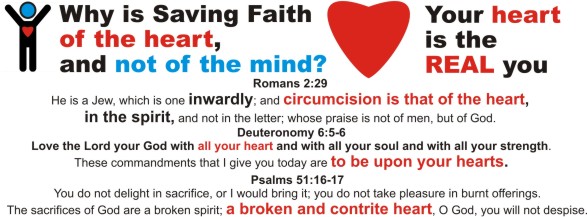
Note: JUST A REMINDER: Jonathan Edwards continuously uses expressions like "gracious dispositions" and "piety of heart". These expressions refer to a supernaturally "regenerated heart" by "saving grace". The reason salvation is of the heart and not the mind is obvious...but Edwards keeps repeating the same truth many different ways in his fight against the arguments for the practice of "Owning The Covenant". It cannot be justly pretended, as a reason why the opinion concerning doctrines should be professed, and not friendship or respect of heart, that the former is more easily discerned and known by us than the latter. For though it be true, that men may be at a loss concerning the latter, yet it is as true they may be so concerning the former too. They may be at a loss in many cases concerning the fulness of the determination of their own inclination and choice; and so they may concerning the fulness of the determination of their judgment. I know of nothing in human nature that hinders the acts of men's wills being properly subject to their own consciousness, any more than the acts of their judgment; nor of any reason to suppose that men may not discern their own consent, as well as their assent. The Scripture plainly supposes gracious dispositions and acts to be things properly under the eye of conscience. 2 Cor 13:5. "Know ye not your ownselves?" John 21:15. "Simon, son of Jonas, lovest thou me?" and many other places. Nor is the nature of godliness less made known, that the true doctrines of religion. Piety of heart, in the more essential things belonging to it, is as clearly revealed, as the doctrines concerning the nature of God, and person of the Messiah, and the method of his redemption. We find in Scripture, that all those of God's professing people or visible saints who are not truly pious, are represented as counterfeits, as having guile, disguise, and a false appearance, as making false pretences, and as being deceitful and hypocrites. — Thus Christ says of Nathanael, John 1:47. "Behold an Israelite indeed, in whom is no guile;" that is, a truly gracious person; implying, that those of God's professing people, who are not gracious, are guileful, and deceitful in their profession. So sinners in Zion, or in God's visible church, are called hypocrites. Isa 33:14. "The sinners in Zion are afraid, fearfulness hath surprised the hypocrites." Isaiah 11:17 . "Every one is an hypocrite and an evil-doer." So they are called lying children, Isa 30:9. and Isa 59:13. and are represented as lying, in pretending to be of the temple or church of God. Jer 7:2,4. These are spoken of as falsely calling themselves of the holy city, Isa 48:1,2. They are called silverdross, and reprobate or refuse silver, (Ezek 22:18. Jer 6:30.) which glisters and shows like true silver, but has not its inward worth. So they are compared to adulterated wine, Isa 1:22. and to trees full of leaves, bidding fair for fruitfulness, Matt 21:19. Clouds that look as if they were full of rain, yet bring nothing but wind, Jude 12. Wells without water, that do but cheat the thirsty traveller, 2 Peter 2:13. A deceitful bow, that appears good, but fails the archer, Ps 78:57. Hos 7:16. — Mr. Stoddard, in his Appeal to the Learned, from time to time, supposes all visible saints, who are not truly pious, to be hypocrites, as in page 15, 17, 18. Now what ground or reason can there be thus to represent those to be visible saints, or members of God's visible church, who are not truly pious, if the profession of such does not imply any pretence to true piety; and when they never made a pretence to any thing more than common grace, or moral sincerity, which many of them truly have, and therefore are not at all hypocritical or deceitful in their pretences, and are as much without guile, in what they make a profession of, as Nathanael was? The psalmist speaking of sincere piety, calls it truth in the inward parts. Ps 51:6. "Behold, thou desirest truth in the inward parts." It is called truth with reference to some declaration or profession made by God's visible people; but on the hypothesis which I oppose, common grace is as properly truth in the inward parts, in this respect, as saving grace. Note: Common grace is available to all living things. Only regenerate persons experience saving grace. Edwards is saying the hypothesis that common grace would be considered "truth in the inward parts" is wrong. An unregenerte heart can not experience "truth in the inward parts". Once again we see how Scottish Common Sense Realism blows up orthodox salvation. John Witherspoon wrote: “every holy disposition must be examined, not by its absolute, but its comparative strength; and the true knowledge of our state arises from the conclusion and result of the whole” and “an unregenerate person is said to have no true love to God or his neighbour only because it is not the most dominant love, and only the most dominant love will be accepted as true or sincere”. God says concerning Israel, Deut 32:5. "Their spot is not the spot of his children." God here speaks of himself, as it were, disappointed; the words having reference to some profession they had made. For why should the remark be made, after this manner, that spots appeared upon them, and showed marks that they were not his children, if they never pretended to be his children, and never were accepted under any such notion to any of the privileges of his people? God is pleased to represent himself in his word as if he trusted the profession of his visible people, and as disappointed when they did not approve themselves as his faithful, stedfast, and thorough friends. Isa 63:8,9,10. "For he said, Surely they are my people, children that will not lie. So he was their Saviour: in all their affliction he was afflicted. But they rebelled and vexed his Holy Spirit: therefore he was turned to be their enemy." The same is represented in many other places. I suppose that God speaks after this manner, because, in his present external dealings with his visible people, he does not act in the capacity of the Searcher of hearts, but accommodates himself to their nature, and the present state and circumstances of his church, and speaks to them and treats them after the manner of men, and deals with them in their own way. But supposing the case to be even thus, there would be no ground for such representations, if there were no profession of true godliness. When God is represented as trusting that men will be his faithful friends, we must understand that he trusts to their pretences. But how improperly would the matter be so represented, if there were no pretences to trust to, no pretences of any real thorough friendship! However there may be a profession of some common affection that is morally sincere, yet there is no pretence of loving him more than, yea not so much as, his enemies. — What reason to trust that they will be faithful to God as their master, when the religion they profess amounts to no more than serving two masters? What reason to trust that they will be stable in their ways, when they do not pretend to be of a single heart, and all know that the double-minded persons used to be unstable in all their ways? Those who only profess moral sincerity or common grace, do not pretend to love God above the world. And such grace is what God and man know is liable to pass away as the early dew, and the morning cloud. — If what men profess amounts to nothing beyond lukewarmness, it is not to be expected, that they will be faithful to the death. If men do not pretend to have any oil in their vessels, what cause can there be to trust that their lamps will not go out? If they do not pretend to have any root in them, what cause is there for any disappointment when they wither away. When God, in the forementioned place, Isa 63. represents himself as trusting Israel's profession, and saying, "Surely they are my people, children that will not lie;" it cannot be understood, as if he trusted that they were his people in that sense, in which the ten tribes were called God's people after they had given up themselves to idolatry for two or three hundred years together without once repenting. But, surely they are my sincere saints and children, as they profess to be, Israelites indeed, without guile; they would not do so evil a thing as to make a lying profession. This seems to be the plain import of the words. It therefore shows that the profession they made was of real vital godliness. The eight first verses of the fifty-sixth chapter of Isaiah,. I think, afford good evidence, that such qualifications are requisite in order to the privileges of a visible church state, as I have insisted on. — In the four preceding chapters we have a prophecy of gospel-times, the blessed state of things which the Messiah should introduce. The prophecy of the same times is continued in the former part of this chapter. Here we have a prophecy of the abolishing of the ceremonial law, which was a wall of separation, that kept two sorts of persons, (viz. eunuchs and Gentiles,) out from the ordinances of the church or congregation of the Lord, (for the words congregation and church are the same,) the place of whose meeting was in God's house within God's walls, verse 5. and on God's holy mountain, verse 7. That in the ceremonial law which especially kept out the Gentiles, was the law of circumcision; and the law that the eunuch shall not enter into the congregation or church of the Lord, we have in Deut 23:1. Now here it is foretold, that in the days when "God's salvation shall be come, and his righteousness revealed," by the coming of the Messiah, this wall of separation should be broken down, this ceremonial law removed out of the way; (but still taking care to note, that the law of the Sabbath shall be continued, as not being one of those ceremonial observances which shall be abolished;) and then it is declared, what is the great qualification which should be looked at in those blessed days, when these external ceremonial qualifications of circumcision and soundness of body should no more be insisted on, viz. piety of heart and practice, "joining themselves to the Lord, loving the name of the Lord, to be his servants, choosing the things that please him," &c. Verse 3, &c. "Neither let the son of the stranger that hath joined himself to the Lord, speak, saying, The Lord hath utterly separated me from his people; neither let the eunuch say, Behold, I am a dry tree; for thus saith the Lord unto the eunuchs that keep my Sabbaths, and choose the things that please me, and take hold of my covenant, even unto them will I give in my house, and within my walls, a place, and a name better than of sons and of daughters; I will give unto them an everlasting name, that shall not be cut off. Also the sons of the stranger that join themselves to the Lord, to serve him, and to love the name of the Lord, to be his servants, every one that keepeth the Sabbath from polluting it, and taketh hold of my covenant: even them will I bring to my holy mountain, and make them joyful in my house of prayer; their burnt-offerings and their sacrifices shall be accepted upon mine altar: for mine house shall be called an house of prayer for all people. The Lord God which gathered the outcasts of Israel, saith, Yet will I gather others to him besides those that are gathered unto him." Section 5: The representations which Christ makes of his visible church, from time to time, in his discourses and parables The representations which Christ makes of his visible church, from time to time, in his discourses and parables, make the thing manifest which I have laid down. This is required by the representation which Christ makes in the latter end of Matthew vii. of the final issue of things with respect to the different sorts of members of his visible church. Those that only say, Lord, Lord, and those who do the will of his Father which is in heaven; those who build their house upon a rock, and those who build upon the sand. They are all (of both kinds) evidently such as have pretended to a high honour and regard to Christ, have claimed an interest in him, and accordingly hoped to be finally acknowledged and received as his. Those visible Christians who are not true Christians cry, Lord, Lord; that is, are forward to profess respect and claim relation to him; and will be greatly disappointed hereafter in not being owned by him. They shall then come and cry, Lord, Lord. This compellation, Lord, is commonly given to Jesus Christ in the New Testament, as signifying the special relation which Christ stood in to his disciples, rather than his universal dominion. They shall then come and earnestly claim relation, as it is represented of Israel of old, in the day of their distress, and God's awful judgments upon them, Hos 8:2. "Israel shall cry unto me, My God, we know thee." To know does not here intend speculative knowledge, but knowing as one knows his own, with a peculiar respect and interest. These false disciples shall not only claim an interest in Christ, but shall plead and bring arguments to confirm their claim; "Lord, Lord, have we not prophesied in they name, and in thy name have cast out devils, and in thy name have done many wonderful works?" It is evidently the language of those that are dreadfully disappointed. "Then (says Christ) I will profess unto them, I never knew you; depart from me, ye that work iniquity:" q.d. "Though they profess a relation to me, I will profess none to them; though they plead that they know me, and have an interest in me, I will declare to them that I never owned them as any of mine; and will bid them depart from me as those that I will never own, nor have any thing to do with in such a relation as they claim." Thus all the hopes they had lived in, of being hereafter received and owned by Christ as in the number of his friends and favourites, are dashed in pieces. — This is further illustrated by what follows, in the comparison of the wise man who built his house on a rock; representing those professed disciples who build their hope of an interest in him on a sure foundation, whose house shall stand in the trying day: and the foolish man who built his house on the sand; representing those professed disciples or hearers of his word, who build their opinion and hope of an interest in him on a false foundation, whose house in the great time of trial shall have a dreadful fall, their vain hope shall issue in dismal disappointment and confusion. Mr. Stoddard says, (Appeal, page 4, 5.) Upon which I take leave to observe, that the king's coming in to see the guests, means Christ's visiting his professing church at the day of judgment, I make no doubt; but, that the guests coming into the king's house means persons coming for salvation at the day of judgment, I am not convinced. If it may properly be represented, that any reprobates will come for salvation at the day of judgment, they will not do so before the king appears; but Christ will appear first, and then they will come and cry to him for salvation. — Whereas, in this parable, the guests are represented as gathered together in the king's house before the king appears, and the king as coming in and finding them there; where they had entered while the day of grace lasted, while the door was kept open, and invitations given forth; and not like those who come for salvation at the day of judgment, Luke 13:25. who come "after the door is shut, and stand without knocking at the door." None, I suppose, will say, this righteousness that is so pure, is the common grace of lukewarm professors, and those that go about to serve God and mammon. The same wedding-garment we have an account of in Ps 45:13,14. "The king's daughter is all glorious within, her clothing is of wrought gold: she shall be brought unto the king in raiment of needle-work." But we need go no where else but to the parable itself; that alone determines the matter. The wedding-garment spoken of as that without which professors will be excluded from among God's people at the day of judgment, is not moral sincerity, of common grace, but special saving grace. If common grace were the wedding-garment intended, not only would the king cast out those whom he found without a wedding-garment, but also many with a wedding-garment: for all such as shall be found then with no better garment than moral sincerity, will be bound hand and foot, and cast into outer darkness; such a wedding-garment as this will not save them. So that true piety, unfeigned faith, or the righteousness of Christ which is upon every one that believeth, is doubtless the wedding-garment intended. But if a person has good and proper ground to proceed on in coming into the king's house, that knows he is without this wedding-garment, why should the king upbraid him, saying, "How camest thou in hither, not having a wedding-garment?" And why should he be speechless, when asked such a question? Would he not have had a good answer to make? viz. "Thou thyself hast given me leave to come in hither, without a wedding-garment." Or this, "Thy own word is my warrant; which invited such as had only common grace, or moral sincerity, to come in." What took place, in fact, in the manner and circumstances of the admission of members into the primitive christian church, and the profession they made in order to their admission, as recorded in the Acts of the Apostles, will further confirm the point. We have an account, concerning these, of their being first awakened by the preaching of the apostles and other ministers, and earnestly inquiring what they should do to be saved, and of their being directed to repent and believe on the Lord Jesus, as the way to have their sins blotted out, and to be saved; and then, upon their professing that they did believe, of their being baptized and admitted into the christian church. Now can any reasonably imagine, that these primitive converts, when they made that profession in order to their admission, had any such distinction in view as that which some now make, of two sorts of real Christianity, two sorts of sincere faith and repentance, one with a moral and another with a gracious sincerity? Or that the apostles, who disciplined them and baptized them, had instructed them in any such distinction? The history informs us of their teaching them but one faith and repentance; Believing in Christ that they might be saved, and repentance for the remission of sins; and it would be unreasonable to suppose, that a thought of any lower or other kind entered into the heads of these converts, when immediately upon their receiving such instructions they professed faith and repentance; or that those who admitted them understood them as meaning any other but what they professed. Let us particularly consider what we are informed concerning those multitudes, whose admission we have an account of in Acts 2. We are told concerning the three thousand first converts, that they were greatly awakened by the preaching of the apostles, pricked in their hearts, made sensible of their guilt and misery; "and said to Peter, and the rest of the apostles, Men and brethren, what shall we do?" i.e. What shall we do to be saved, and that our sins may be remitted? Upon which they directed them what they should do, viz. "Repent, and be baptized, in the name of the Lord Jesus, for the remission of sins." They are here directed into the way of salvation, viz. faith and repentance, with a proper profession of these. — Then, we are told, that they which gladly received the word were baptized; that is, They which appeared gladly to receive the word, or manifested and professed a cordial and cheerful compliance with the calls of the word, with the directions which the apostles had given them. The manifestation was doubtless by some profession, and the profession was of that repentance for the remission of sins, and that faith in Christ, which the apostles had directed them to, in answer to their inquiry, what they should do to be saved? I can see no ground to suppose they thought of any lower or other kind. And it is evident by what follows, that these converts now looked upon it that they had complied with these directions, and so were at peace with God. Their business now is to rejoice and praise God from day to day; "They continued stedfastly in the apostles' doctrine and fellowship — continuing daily with one accord in the temple, and breaking bread from house to house, they did eat their meat with gladness and singleness of heart, praising God." The account of them now is not as of persons under awakenings, weary and heavy-laden sinners, under an awful sense of guilt and wrath, pricked in their hearts, as before; but of persons whose sorrow was turned into joy, looking on themselves as now in a good estate. And in the last verse it is said, "The Lord added to the church daily such as should be saved;" in the original it is "soozomenous" the saved; "soozomenous" was a common appellation given to all visible Christians, or to all members of the visible christian church. It is as much as to say, the converted, or the regenerate. Being converted is in Scripture called being saved, because it is so in effect; they were "passed from death to life," John 5:24. Titus 1:4. "According to his mercy he saved us, by the washing of regeneration, and the renewing of the Holy Ghost." 2 Tim 1:9. "Who hath saved us, and called us with an holy calling." Not that all who were added to the visible church were indeed regenerated, but they were so in profession and repute, and therefore were so in name. 1 Cor 1:18. "The preaching of the cross is to them that perish, foolishness; but unto us [i. e. us Christians] which are saved "soozomenous" it is the power of God." So those that from time to time were added to the primitive church, were all called Before, while under awakenings, they used to inquire of their teachers, what they should do to be saved; and the directions that used to be given them, were to repent and believe in Christ; and before they were admitted into the church, they professed that they did so; and thenceforward, having visibly complied with the terms proposed, they were called the saved; it being supposed, that they now had obtained what they inquired after when they asked what they should do to be saved. Accordingly we find that Christ's ministers treated them no more as miserable perishing sinners, but as true converts; not setting before them their sin and misery to awaken them, and to convince them of the necessity of a Saviour, exhorting them to fly from the wrath to come, and seek conversion to God; but exhorting them to hold fast the profession of their faith, to continue in the grace of God, and persevere on holiness; endeavouring by all means to confirm and strengthen them in grace. Thus when a great number believed and turned to the Lord at Antioch, Barnabas was sent to them; "who, when he came, and had seen the grace of God, was glad, and exhorted them all, that with purpose of heart they should cleave to the Lord." Acts 11:23. See also Acts 13:43; 14:22; 15:32,41; 20:32. And when the apostles heard of the conversion of the Gentiles to the christian faith, visible by their profession when they joined themselves to the christian church, they supposed and believed that God had given them saving repentance, and a heart-purifying faith. Acts 11:18. "When they heard these things, they held their peace, and glorified God, saying, Then hath God also granted unto the Gentiles repentance unto life." Acts 15:9. "And put no difference between us and them, purifying their hearts by faith." If any should here object, that when such multitudes were converted from Judaism and heathenism, and received into the christian church in so short a season, it was impossible there should be time for each one to say so much in his public profession, as to be any credible exhibition of true godliness to the church: I answer, This objection will soon vanish, if we particularly consider how the case was with those primitive converts, and how they were dealt with by their teachers. It was apparently the manner of the first preachers of the gospel, when their hearers were awakened and brought in good earnest to inquire what they should do to be saved, then particularly to instruct them in the way of salvation, and explain to them what qualifications must be in them, or what they must do in order to their being saved, agreeable to Christ's direction, Mark 16:15,16. This we find was the method they took with the three thousand, in the second chapter of Acts, verse 37-40. And it seems, they were particular and full in it: they said much more to them than the words recorded. It is said, verse 40. "With many other words did Peter testify and exhort." And this we find to be the course Paul and Silas took with the jailor, Acts 16. Who also gave more large and full instructions than are rehearsed in the history. And when they had thus instructed them, they doubtless saw to it, either by themselves or some others who assisted them, that their instructions were understood by them, before they proceeded to baptize them. For I suppose, none with whom I have to do in this controversy, will maintain, from the apostles' example, that we ought not to insist on a good degree of doctrinal knowledge in the way and terms of salvation, as requisite to the admission of members into the church. And after they were satisfied that they well understood these things, it took up no great time to make a profession of them, or to declare that they did, or found in themselves, those things they had been told of as necessary to their salvation. After they had been well informed what saving faith and repentance were, it took up no more time to profess that faith and repentance, than any other. — In this case not only the converts' words, but the words of the preacher, which they consented to, and in effect made their own, are to be taken into their profession. For persons that are known to be of an honest character, and manifestly qualified with good doctrinal knowledge of the nature of true godliness, in the more essential things which belong to it, solemnly to profess they have or do those things, is to make as credible a profession of godliness as I insist upon. And we may also well suppose, that more words were uttered by the professors, and with other circumstances to render them credible, than are recorded in that very brief history, which we have of the primitive church in the Acts of the Apostles; and also we may yet suppose one thing further, viz. that in that extraordinary state of things so particular a profession was not requisite in order to the church's satisfaction, either of doctrines assented to, or of the consent and disposition of the heart, as may be expedient in a more ordinary state of things; for various reasons that might be given, would it not too much lengthen out this discourse. One thing which makes it very evident, that the inspired ministers of the primitive christian church looked upon saving faith as the proper matter of the profession requisite in order to admission into the church, is the story of Philip and the eunuch, in Acts 8. For when the eunuch desires to be baptized, Philip makes answer, verse 37. "If thou believest with all tine heart, thou mayst." Which words certainly imply, that believing with all his heart was requisite in order to his coming to this ordinance properly and in a due manner. I cannot conceive what should move Philip to utter these words, or what he should aim at in them, if at the same time he supposed, that the eunuch had no need to look at any such qualification in himself, or at all to inquire whether he had such a faith, in order to determine whether he might present himself as the subject of baptism. It is said by some, that Philip intended nothing more by believing with all his heart, than that he believed that doctrine, that Jesus Christ was the Son of God, with a moral sincerity of persuasion. But here again I desire, that the Scripture may be allowed to be its own interpreter. The Scripture very much abounds with such phrases as this, with all the heart, or with the whole heart, in speaking of religious matters. And the manifest intent of them is to signify a gracious simplicity and godly sincerity. Thus, 1 Sam 12:20. "Turn not aside from following the Lord, but serve the Lord with all your heart." So verse 24. "Only fear the Lord, and serve him in truth, with all your heart." 1 Kings 8:23. "Who keepest covenant and mercy with thy servants, that walk before thee with all their heart." 1 Kings 14:8. "My servant David, who kept my commandments, and who followed me with all his heart." 2 Kings 10:31. "But Jehu took no heed to walk in the law of the Lord God of Israel with all his heart." 2 Chron 22:9. "Jehoshaphat sought the Lord with all his heart." 2 Chron 31:20,21. "Hezekiah wrought that which was good and right and truth before the Lord his God; and in every work that he began in the service of the house of God, and in the law, and in the commandments, to seek his God, he did it with all his heart." Ps 9:1. "I will praise thee, O Lord, with my whole heart." Ps 86:12. "I will praise thee, O Lord my God, with all my heart, and will glorify thy name." Ps 111:1. "I will praise thee, O Lord, with my whole heart, in the assembly of the upright." And Ps 119:2. "Blessed are they that keep his testimonies, and that seek him with the whole heart." Verse 10. "With my whole heart have I sought thee." Verse 34. "Give me understanding, and I shall keep thy law, yea, I shall observe it with my whole heart." Verse 69. "The proud have forged a lie against me, but I will keep thy precepts with my whole heart." Jer 24:7. "And I will give them an heart to know me — for they shall return unto me with their whole heart." Joel 2:12,13. "Turn ye even unto me with all your heart — and rend your heart, and not your garments." And we have the like phrases in innumerable other places. And I suppose that not so much as one place can be produced, wherein there is the least evidence or appearance of their being used to signify any thing but a gracious sincerity. And indeed it must be a very improper use of language, to speak of those as performing acts of religion with all their hearts, whose heart the Scriptures abundantly represent as under the reigning power of sin and unbelief — and as those that do not give God their hearts, but give them to other things — as those who go about to serve two masters, and who draw near to God with their lips, but have at the same time their hearts far from him, running more after other things; and who have not a single eye, nor single heart. The word believe, in the New Testament, answers to the word trust in the Old; and therefore the phrase used by Philip, of believing with all the heart, is parallel to that in Prov 3:5. "Trust in the Lord with all thine heart." And believing with the heart is a phrase used in the New Testament, to signify saving faith. — Rom 10:9,10. "If thou shalt believe in thine heart, that God hath raised him from the dead, thou shalt be saved; for with the heart man believeth unto righteousness." The same is signified by obeying the form of doctrine from the heart, Rom 6:17,18. "But God be thanked, that ye were the servants of sin, but ye have obeyed from the heart that form of doctrine which was delivered you; being then made free from sin, ye became the servants of righteousness." Here it is manifest, that saving faith is intended by obeying the form of doctrine from the heart. And the same is signified as if it had been said, "ye have believed with the heart" the form of doctrine. But Philip uses a yet stronger expression, he does not only say, if thou believest with the heart, or from the heart, but with all thine heart. Besides, for any to suppose, that those same persons which the Scriptures represent in some places as under the power of an evil heart of unbelief — as double-minded with regard to their faith, (James 1:6,7,8.) who, though they believe for a while, have their hearts like a rock, in which faith has no root, (Luke 8:13.) — and yet that this same sort of persons are in other scriptures spoken of as believing with all their heart; I say, for any to suppose this, would be to make the voice of God's word not very harmonious and consonant to itself. — And one thing more I would observe on this head, there is good reason to suppose, that Philip, while he sat in the chariot with the eunuch, and (as we are told) preached unto him Jesus, had showed to him the way of salvation — had opened to him the way of getting an interest in Christ, or obtaining salvation by him, viz. believing in him, agreeable to Christ's own direction, Mark 16:15,16. and agreeable to what we find to be the manner of the first preachers of the gospel. And therefore, when after this discourse he puts it to the eunuch, whether he believed with all his heart; it is natural to suppose, that he meant whether he found his heart acquiescing in the gospel-way of salvation, or whether he sincerely exercised that belief in Christ which he had been inculcating; and it would be natural for the eunuch so to understand him. Here if it be objected, that the eunuch's answer and the profession he hereupon made, (wherein he speaks nothing of his heart, but barely says,) I believe that Jesus Christ is the Son of God, shows that he understood no more by the inquiry, than whether he gave his assent to that doctrine: to this I answer; we must take this confession of the eunuch together with Philip's words, to which they were a reply, and expound the one by the other. Nor is there any reason but to understand it in the same sense in which we find the words of the like confession elsewhere in the New Testament, and as the words of such a confession were wont to be used in those days; as particularly the words of Peter's confession, Matt 16:16. "And Simon Peter answered and said, Thou art Christ, the Son of the living God." Which was a profession of saving faith, as appears by what Christ says upon it. And we read, 1 Cor 12:3. "No man can say, that Jesus is the Lord, but by the Holy Ghost." Not but that a man might make a profession in these words without the Holy Ghost, but he could not do it heartily, or with all his heart. So 1 John 4:15. "Whosoever shall confess that Jesus is the Son of God, God dwelleth in him, and he in God." i.e. Whoever makes this christian confession (this profession which all Christians were wont to make) cordially, or with his whole heart, God dwells in him, &c. But it was thus that the eunuch was put upon making this confession. The epistles of the apostles to the churches, prove what has been asserted.
It is apparent by the epistles of the apostles to the primitive christian churches, their manner of addressing and treating them throughout all those epistles, and what they say to them and of them, that all those churches were constituted of members so qualified as has been represented, having such a visibility of godliness as has been insisted on. Those who were reputed to be real saints, were taken into the church under a notion of their being truly pious persons, made that profession, and had this hope of themselves; and that natural and graceless men were not admitted designedly, but unawares, and beside the aim of the primitive churches and ministers; and that such as remained in good standing, and free from an offensive behaviour, continued to have the reputation and esteem of real saints, with the apostles, and one another. And the same apostle speaks of great numbers among the Galatians, who had made a high profession, and were such as he had thought well of when they were first admitted into the church, but since had given him cause to doubt of their state, by giving heed to seducers, that denied the great gospel-doctrine of justification by faith alone: yet notwithstanding, the apostle speaks of them in such language as shows surprise and disappointment, and implies that he had looked upon them as true Christians, and hoped that his labours among them had had a saving effect upon them. "I marvel that ye are so soon removed from him that called you into the grace of Christ, unto another gospel." Gal 4:11. "I am afraid of you, lest I have bestowed upon you labour in vain." And verse 20. "I desire to be present with you now, and change my voice; for I stand in doubt of you." As much as to say, "I have heretofore addressed you with the voice of love and charity, as supposing you the dear children of God; but now I begin to think of speaking to you in other language." In the same chapter, to show them what little reason he had to expect that they would come to this, he puts them in mind of the great profession they had made, and the extraordinary appearances there had formerly been in them of fervent piety. — Verse 15. "Where is the blessedness you spake of? For I bear you record, that if it had been possible, you would have plucked out your own eyes, and have given them unto me." The apostle James, in his epistle, speaks of scandalous persons among the twelve tribes that were scattered abroad; some that were men of unbridled tongues; some that seem to have been a kind of antinomians in their principles, and of a very bitter and violent spirit, that reproached, condemned, and cursed their brethren, and raised wars and fightings among professing Christians, and were also very unclean in their practice, adulterers and adulteresses, James 4:4. And in the fifth chapter of his epistle, he seems to speak to the unbelieving Jews, who persecuted the Christians, verse 6. — And the apostles also often speak of some who had once been admitted into the church, crept in unawares, but who apostatized from Christianity, and finally proved notoriously wicked men. — But otherwise, and as to such members of the visible church as continued in the same good standing and visibility of Christianity, wherein they were admitted, it is evident by the epistles of the apostles, they were all in the eye of a christian judgment truly pious or gracious persons. And here I desire the following things may be particularly observed. The apostles continually, in their epistles, speak to them and of them, as supposing and judging them to be gracious persons. Thus the apostle Paul, in his epistle to the Rom 1:7. speaks of the members of that church as beloved of God. In Rom 6:17,18., &c. he "thanks God, that they had obeyed from the heart that form of doctrine which had been delivered them, — were made free from sin, and become the servants of righteousness," &c. The apostle in giving thanks to God for this, must not only have a kind of negative charity for them, as not knowing but that they were gracious persons, and so charitably hoping (as we say) that it was so; but he seems to have formed a positive judgment that they were such. His thanksgiving must at least be founded on rational probability; since it would be but a mocking of God, to give thanks for bestowing a mercy which at the same time he did not see reason positively to believe was bestowed. In Rom 7:4-6. The apostle speaks of them as those that once were in the flesh, and were under the law, but now delivered from the law, and dead to it. In Rom 8:15., and following verses, he tells them, they had received the Spirit of adoption, and speaks of them as having the witness of the Spirit that they were the children of God, heirs of God, and joint heirs with Christ. And the whole of his discourse, to the end of the chapter, implies, that he esteemed them truly gracious persons. In Rom 9:23,24. he speaks of the christian Romans, together with all other Christians, both Jews and Gentiles, as vessels of mercy. In Rom 14:6,7,8. speaking of the difference that then was among professing Christians, in point of regard to the ceremonial institutions of the law, he speaks of both parties as acting from a gracious principle, and as those that lived to the Lord, and should die unto the Lord; "He that regardeth the day, regardeth it unto the Lord, &c. For none of us liveth to himself, and no man [i e. none of us] dieth to himself. For whether we life, we live unto the Lord, or whether we die, we die unto the Lord: whether we live therefore or die, we are the Lord's." In Rom 15:14. he says, "I myself also am persuaded of you, my brethren, that ye are full of goodness." His being thus persuaded implies a positive judgment of charity. And the same apostle in his first epistle to the Corinthians, directs it "to the church at Corinth, that are sanctified in Christ Jesus, called to be saints, with all that in every place call on the name of the Lord Jesus;" i.e. to all visible Christians through the world, or all the members of Christ's visible church every where. And continuing his speech, 1 Cor 1:8. he speaks of them as those "that God would confirm to the end, that they may be blameless in the day of our Lord Jesus Christ:" plainly speaking of them all as persons, in christian esteem, savingly converted. In the next verse, he speaks of the faithfulness of God as engaged thus to preserve them to salvation, having called them to the fellowship of his Son. And in the 30 th verse., he speaks of them as having a saving interest in Christ; "Of him are ye in Christ Jesus; who of God is made unto us wisdom, righteousness, sanctification, and redemption." In 1 Cor 3:21-23. he says to the members of the church of Corinth, "All things are yours, whether Paul, or Apollos, or Cephas, or the world, or life, or death, or things present, or things to come; all are yours, and ye are Christ's." In 1 Cor 4:15. he tells them, he had begotten them through the gospel. In 1 Cor 6:1-3. he speaks of them as "those who shall judge the world, and shall judge angels." And in verse 11. he says to them, "Ye are washed, ye are sanctified, ye are justified, in the name of the Lord Jesus, and by the Spirit of God." And in 1 Cor 15:49., to the end, he speaks of them as having an interest, with him and other Christians, in the happiness and glory of the resurrection of the just. And in his second epistle, 2 Cor 1:7. he says to them, "Our hope of you is stedfast; knowing that as you are partakers of the sufferings, so shall ye be also of the consolation." This stedfast hope implies a positive judgment. We must here understand the apostle to speak of such members of the church of Corinth, as had not visibly backslidden. Again, in the 14 th and 15 th verses., he speaks of a confidence which he had, that they should be his rejoicing in the day of the Lord Jesus. In all reason we must conclude, there was a visibility of grace, carrying with it an apparent probability in the eyes of the apostle, which was the ground of this his confidence. Such an apparent probability, and his confidence as built upon it, are both expressed in 2 Cor 3:3,4. "Ye are manifestly declared to be the epistle of Christ, ministered by us; written not with ink, but with the Spirit of the living God; not in tables of stone, but in the fleshy tables of the heart; and such trust have we through Christ to God-ward." And in verse 18. the apostle speaks of them, with himself and other Christians, as all with open face beholding, as in a glass, the glory of the Lord, and being changed into the same image, from glory to glory. And in the epistle to the churches of Galatia. Gal 4:26. the apostle speaks of visible Christians, as visibly belonging to heaven, the Jerusalem which is above. And, verse 28, 29. represents them to be the children of the promise, as Isaac was; and born after the Spirit. In the 6 th verse. of the same chapter, he says to the christian Galatians, "Because ye are sons, God hath sent forth the Spirit of his Son into your hearts, crying, Abba, Father." And Gal 6:1. he speaks of those of them that had not fallen into scandal, as spiritual persons. In his epistle to that great church at Ephesus, he blesses God on behalf of its members, as being, together with himself and all the faithful in Christ Jesus, "Chosen in him before the foundation of the world, to be holy and without blame before him in love, being predestinated to the adoption of children by Jesus Christ to himself, according to the good pleasure of his will, to the praise of the glory of his grace, wherein God had made them accepted in the beloved: in whom they had redemption through his blood, the forgiveness of sins." In Eph 1:13,14. he thus writes to them, "In whom ye also trusted — In whom after ye believed, ye were sealed with that Holy Spirit of promise, which is the earnest of our inheritance, until the redemption of the purchased possession." And in Eph 2. at the beginning; "You hath he quickened, who were dead in trespasses and sins." With much more, showing that they were, in a charitable esteem, regenerated persons, and heirs of salvation. So in the epistle to the church at Philippi, the apostle tells them, that he "thanks God upon every remembrance of them, for their fellowship in the gospel; being confident of this very thing, that he which had begun a good work in them, would perform it until the day of Christ: even (says he) as it is meet for me to think this of you all." If it was meet for him to think this of them, and to be confident of it, he had at least some appearing rational probability to found his judgment and confidence upon; for surely it is not meet for reasonable creatures to think at random, and be confident without reason. In Phil 1:25,26. he speaks of his "confidence that he should come to them for their furtherance and joy of faith, that their rejoicing might be more abundant in Christ Jesus." Which words certainly suppose that they were persons who had already received Christ, and comfort in him; had already obtained faith and joy in Christ, and only needed to have it increased. In the epistle to the members of the church at Colosse, the apostle saluting them in the beginning of the epistle, "gives thanks for their faith in Christ Jesus, and love to all saints, and the hope laid up for them in heaven;" and speaks of "the gospel bringing forth fruit in them, since the day they knew the grace of God in truth;" i.e. since the day of their saving conversion. In Col 1:8. he speaks of "their love in the Spirit;" and verse 12-14. as "made meet to be partakers of the inheritance of the saints in light; as being delivered from the power of darkness, and translated into the kingdom of God's dear Son; as having redemption through Christ's blood, and the forgiveness of sins." In Col 3, at the beginning, he speaks of them as "risen with Christ; as being dead; [i. e. to the law, to sin, and the world;] as having their life hid with Christ in God;" and being such as, "when Christ their life should appear, should appear with him in glory." In verse 7. he speaks of them as "having once walked and lived in lusts, but as having now put off the old man with his deeds, and put on the new man, which is renewed in knowledge, after the image of him that created him." In the first epistle to the members of the church at Thessalonica, in words annexed to his salutation, chapter 1, he declares what kind of visibility there was of their election of God, in the appearance there had been of true and saving conversion, and their consequent holy life, verse 3-7. And in the beginning of the second epistle., he speaks of their faith and love greatly increasing; and in verse 7. expresses his confidence of meeting them in eternal rest, when the Lord Jesus Christ should be revealed from heaven with his mighty angels. And in 2 Thess 2:13. he gives thanks to God, that from the beginning he had chosen them to salvation. The apostle James, writing to the Christians of the twelve tribes which were scattered abroad, speaks of them as regenerated persons, meaning, as I observed before, those which were in good standing. James 1:18. "Of his own will begat he us by the word of truth, that we should be a kind of first-fruits of his creatures." The apostle Peter writing to the Jewish Christians, scattered throughout Pontus, Galatia, Cappadocia, Asia, and Bithynia, (large countries, and therefore they must in the whole be supposed to be a great multitude of people,) to all these, gives the title of elect, according to the foreknowledge of God the Father, through sanctification of the Spirit unto obedience, and sprinkling of the blood of Jesus Christ. And in the verses next following, speaks of them as regenerated, "or begotten again to a lively hope, to an inheritance incorruptible," &c. And as "kept by the power of God through faith unto salvation." And says to them in verse 8, 9. "Whom (namely, Christ) having not seen, ye love; in whom though now ye see him not, yet believing, ye rejoice with joy unspeakable and full of glory; receiving the end of your faith, even the salvation of your souls." And in verse 18., to the end, the apostle speaks of them as "redeemed from their vain conversation, by the precious blood of Christ. — And as having purified their souls in obeying the truth through the Spirit. — Being born again of incorruptible seed," &c. And in the former part of chapter ii. he speaks of them as "living stones, coming to Christ, and on him built up a spiritual house, an holy priesthood, to offer up spiritual sacrifices, acceptable to God through Jesus Christ. — And as those that believe, to whom Christ is precious. — As a chosen generation, a royal priesthood, a holy nation, a peculiar people, called out of darkness into marvellous light." The church at Babylon, occasionally mentioned in 1 Peter 5:13. is said to be elected together with them. And in his second epistle (which appears by 2 Peter 3:1. to be written to the same persons) the inscription is, To them which have obtained like precious faith with us, i.e. with the apostles and servants of Christ. And in the third chapter, he tells them, both his epistles were designed to stir up their pure minds. In verse 20, 21. he tells them, they have an unction from the Holy One, and know all things; and that he did not write to them because they had not known the truth, but because they had known it, &c. And in verse 27. he says, "The anointing which ye have received of him, abideth in you, and ye need not that any man should teach you; but as the same anointing teacheth you of all things, and is true, and is no lie; and even as it hath taught you, ye shall abide in him." And in the beginning of chapter iii. he addresses them as those "who were the sons of God, who when he should appear should be like him, because they should see him as he is." In 1 John 4:4. he says, "Ye are of God, little children, and have overcome," &c. And even the members of the church of Laodicea, the very worst of all the seven churches of Asia, yet looked upon themselves as truly gracious persons, and made that profession; they "said they were rich, and increased in goods, and knew not that they were wretched and miserable," &c. Rev 3:17. And verse 16. "Rejoice evermore." How diverse is this way of treating churches, from the method in which faithful ministers are wont to deal with their congregations, wherein are many that make no pretence to true piety, and from the way in which Mr. Stoddard was wont to deal with his congregation. And how would he have undoubtedly judged such a way of treating them the most direct course in the world eternally to undo them! And shall we determine that the apostle Paul was one of those prophets, who daubed with untempered mortar, and sewed pillows under all arm-holes, and healed the hurt of immortal souls slightly, crying, Peace, peace, when there was no peace. — These things make it most evident, that the primitive churches were not constituted as those modern churches, where persons knowing and owning themselves unregenerate, are admitted, on principle. If it be here objected, that the apostle sometimes exhorts those to whom he writes, to put off the old man, and put on the new man, and to be renewed in the spirit of their minds, &c. as exhorting them to seek conversion: I answer, that the meaning is manifestly this, That they should mortify the remains of corruption, or the old man, and turn more and more from sin to God. Thus he exhorts the Ephesians to be renewed, &c. Eph 4:22,23. whom yet he had before in the same epistle abundantly represented as savingly renewed already; as has been before observed. And the like might be shown of other instances. The same peculiar endearment the apostle has doubtless respect to in 1 Peter 4:8. "Above all things have fervent charity among yourselves." And from time to time, he considers it as a note of their piety. Col 1:4. "We heard of your faith in Christ Jesus, and of the love which ye have to all saints." 1 Thess 4:9. "As touching brotherly love, ye need not that I write unto you; for ye yourselves are taught of God to love one another." So Philem 5. "Hearing of the love and faith, which thou hast towards the Lord Jesus Christ, and towards all saints." And this is what he exhorts to, Heb 13:1. "Let brotherly love continue." 1 Thess 5:26. "Greet all the brethren with an holy kiss." Compare 1 Cor 16:20. 2 Cor 13:12. and 1 Peter 5:14. The word translated long after, is "epipothountoon"; which properly signifies to love with an exceeding and dear love. And this is represented as the bond that unites all the members of the visible church; Acts 4:32. "And the multitude of them that believed were of one heart and one soul." This is the same thing which elsewhere is called being of one mind: 1 Peter 3:8. "Finally, be ye all of one mind." And being of the same mind; 1 Cor 1:10. "That ye he perfectly joined together in the same mind." And Phil 4:2. "I beseech Euodias, and beseech Syntyche, that they be of the same mind in the Lord." And being like-minded, (the word is the same in the Greek,) Rom 15:5,6. "Now the God of patience and consolation grant you to be like-minded one towards another; that ye may with one mind, and one mouth, glorify God, even the Father of our Lord Jesus Christ." There is reason to think, that it is this oneness of mind, or being of one heart and soul, is meant by that charity which the apostle calls the bond of perfectness, Col 3:14. and represents as the bond of union between all the members of the body, in Eph 4:15,16. "But speaking the truth in love, may grow up into him in all things, which is the head, even Christ; from whom the whole body fitly joined together, and compacted by that which every joint supplieth, according to the effectual working in the measure of every part, maketh increase of the body, unto the edifying itself in love." Herein seems much to consist the nature of scandal in the members of a church, viz. such an offence as is a wound and interruption to this kind of affection, being a stumbling — block to a christian judgment, in regard of its esteem of the offender as a real Christian, and what much lessens the visibility of his christian character. And therefore when scandal is removed by visible repentance, the church is directed to confirm their love to the offender, 2 Cor 2:8.
|
