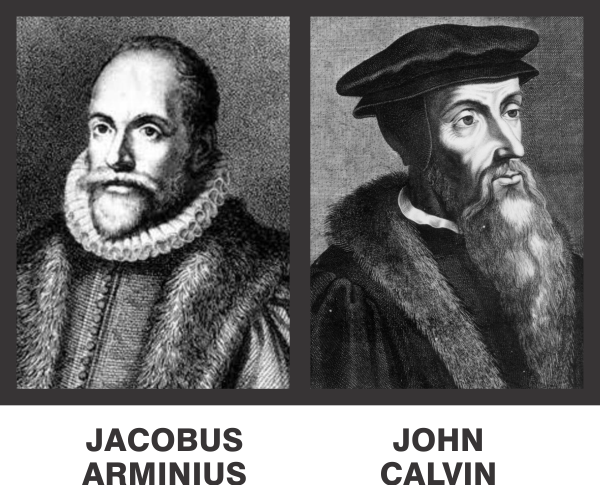
Few people who identify themselves as "Calvinist" have read even a fraction of the extensive works of John Calvin. If you read his Institutes of The Christian Religion, you'll discover things that are contrary to what many modern "Calvinists" believe.
When someone identifies as a "Calvinist", they usually mean they believe at least 3 of the five points of TULIP, which Calvin did not approve, because he had been dead 55 years when it was published.
TULIP was a statement of doctrine designed to counter the theology of Jacob Arminius ( 1560-1609), a theologian who tried to reform the theology which developed from the works of John Calvin (1509-1564), especially the doctrines of unconditional election, the limitation of the atonement to the elect, and irresistible grace.
In response to the doctrinal challenges, Calvinists in 1619 listed the five main points of contention known today asTULIP.
These are the doctrines believed by 5-point Calvinists.
- Total depravity asserts that as a consequence of the fall of man into sin, every person is enslaved to sin. People are not by nature inclined to love God, but rather to serve their own interests and to reject His rule. Thus, all people by their own faculties are morally unable to choose to trust God for their salvation and be saved (the term "total" in this context refers to sin affecting every part of a person, not that every person is as evil as they could be). This doctrine is derived from Calvin's interpretation of Augustine's explanation of original sin. While the phrases "totally depraved" and "utterly perverse" were used by Calvin, what was meant was the inability to save oneself from sin rather than being utterly devoid of goodness.
- Unconditional election asserts that God has chosen from eternity those whom He will bring to Himself not based on foreseen virtue, merit, or faith in those people; rather, His choice is unconditionally grounded in His mercy alone. God has chosen from eternity to extend mercy to those He has chosen and to withhold mercy from those not chosen. Those chosen receive salvation through Christ alone. Those not chosen receive the just wrath that is warranted for their sins against God.
- Limited atonement asserts that Jesus's substitutionary atonement was definite and certain in its purpose and in what it accomplished. This implies that only the sins of the elect were atoned for by Jesus's death. Calvinists do not believe, however, that the atonement is limited in its value or power, but rather that the atonement is limited in the sense that it is intended for some and not all.
- Irresistible grace asserts that the saving grace of God is effectually applied to those whom He has determined to save (that is, the elect) and overcomes their resistance to obeying the call of the gospel, bringing them to a saving faith. This means that when God sovereignly purposes to save someone, that individual will be saved. The doctrine holds that this purposeful influence of God's Holy Spirit cannot be resisted, but that the Holy Spirit, "graciously causes the elect sinner to cooperate, to believe, to repent, to come freely and willingly to Christ." This is not to deny the fact that the Spirit's outward call (through the proclamation of the Gospel) can be, and often is, rejected by sinners; rather, it is that inward call which cannot be rejected.
- Perseverance of the saints asserts that the "saints", those whom God has predestined to salvation, those whom God has called into communion with Himself, will continue in faith until the end by the keeping power of the Holy Spirit. Those who apparently fall away either never had saving faith to begin with (1 John 2:19), or, if they are saved, but not presently walking in the Spirit, they will be divinely chastened (Hebrews 12:5–11) and will repent before they die (1 John 3:6–9).
|