How Saving Faith Is
Trusting God Relates to
Decisional Regeneration
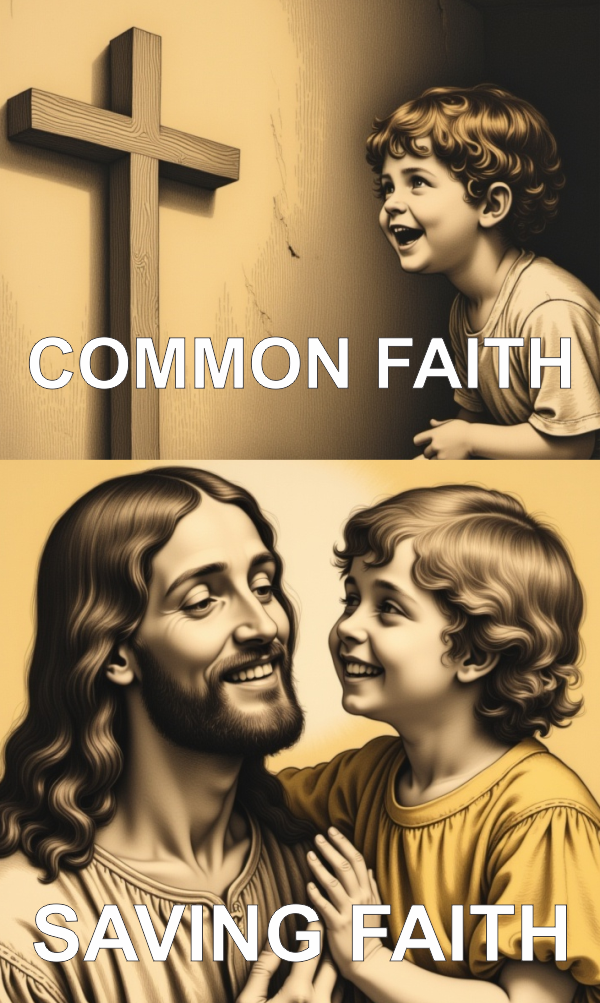
There are many types of faith. This causes a problem when ministers don't qualify whether they are speaking of common faith, where someone merely believes in Christ, or saving faith, where someone is given an all-encompassing trust when God supernaturally changes their heart by regeneration and fills them with the Holy Spirit. There are also many types of repentance. Everyone is sorry for their sins (like Judas), but few people completely reverse direction and do as Christ commanded: "love the Lord your God with all your heart, with all your soul, with all your mind, and with all your strength" (Mark 12:30). A misunderstanding of what the New Testament calls "faith" can cause you to have a mechanical view of salvation. The child in the top picture believes Christ came and died for the sins of people who "repent and are converted so their sins may be blotted out" (Acts 3:19). But where's the evidence he's repented? John the Baptist warned saving repentance always "bear fruits worthy of repentance" (John 3:8). Christ warned, “Not everyone who says to Me, 'Lord, Lord,' shall enter the kingdom of heaven, but he who does the will of My Father in heaven" (Matthew 7:21). It's a good thing to have common faith in Christ, but it must be supernaturally transformed at regeneration into saving faith as shown in the bottom picture. Saving faith is knowing Christ experientially. "This is eternal life, that they may know You, the only true God, and Jesus Christ whom You have sent" (John 17:3). "By this we know that we know Him, if we keep His commandments" (1 John 2:3). The Apostle John warns, "In this the children of God and the children of the devil are manifest: Whoever does not practice righteousness is not of God" (1 John 3:10), and "He who says he abides in Him ought himself also to walk just as He walked" (1 John 2:6). Post-Enlightenment Western man doesn't have the same view of saving faith as the early Christians, who understood God as being the ultimate cause of all things. Jewish scholars prefer to translate "faith" as "trust" to avoid the potential problem the Apostle John saw. John shows in his discussion of LOGOS, a deep knowledge of Greek philosophy. He used the Greek word for faith whose meaning is closer to "trust" than the word for faith used in the other three Gospels. Up until the Enlightenment, Western man saw God as a Personal, all-powerful force, intimately involved with the everyday life of man. But since the Enlightenment, Western man has increasingly seen God an an impersonal force detached from everyday life, so modern evangelicals are likely to understand "faith" as a mechanical acceptance of truth and not a reliance of the object of faith, which is Christ. Did you ever wonder why the Gospel of John never uses the word "faith" in the better translations? John used the Greek word pisteuo, which means "active trust and reliance: Placing personal confidence, reliance, and dependence on someone". Matthew, Mark and Luke use the Greek word, pistis, which means "Conviction: A strong mental acceptance or persuasion that something is true". This has a direct bearing on the subject of Decisional Regeneration. "90% of the people who make a decision for Christ" don't show Biblical evidence of the change of character that takes place when God supernaturally regenerates and fills with the Holy Spirit. They never experience intimacy with God. The modern Evangelical minister doesn't warn them as the Apostles warned the early church: "Brethren, be even more diligent to make your call and election sure" (2 Peter 1: 10). "Examine yourselves as to whether you are in the faith. Test yourselves. Do you not know yourselves, that Jesus Christ is in you?—unless indeed you are disqualified" (2Corinthians 13:5). John wrote his Gospel primarily for a non-Jewish audience. That is why he starts his Gospel with "In the beginning was the Word, and the Word was with God, and the Word was God" (John 1:1). The "Word" was a direct reference to a Greek philosophical idea of an impersonal power that controls everything, or alternatively, an impersonal power that made everything to work the way it does. Jews did not see God in either of these ways, but Greeks either thought many demi-gods controlling the physical elements or there was an abstract, impersonal force of creation. That abstract impersonal force was called the Word, or Reason, or Wisdom, or Knowledge, or First Principle. Matthew, Mark and Luke were not concerned their Jewish audience would misunderstand their use of the word "faith" as an impersonal force like gravity because Jews knew that God was in control of everything that happened. For example, Jews knew if they dropped an object, it fell to the ground because God allowed it. But for the Greek, who thought things could be outside the control of a single, all-powerful, Personal God, gravity (and faith) could be seen as an impersonal force available to man to use as he wished. John did not want the Greeks thinking that faith was a force that could move mountains apart from intimate relationship with God. For this reason, he used the word "believe" 52 times compared to Luke (4 times), Mark (11 times) and Matthew ( 7 times) in the King James Version. Matthew, Mark and Luke did not worry about emphasizing the sovereignty of God when they spoke of faith because the Jews saw everything as controlled by a personal all-powerful God. But John knew if he used the word we translate faith with Greeks, it would be misunderstood, just as it is today by post-Enlightenment Western man. It doesn't matter if you're Arminian or Calvinist or Restorationist...you can prevent false conversions. The problem isn't telling people to immediately repent and believe on the Lord Jesus Christ...the problem is telling people they're saved because of something they've done. Faithful Evangelical ministers examine seekers for Biblical evidence of supernatural regeneration and the indwelling of the Holy Spirit. Here are five evidences God has saved you. 1) You are Obedient to God's Word It's impossible to force or bribe God to save you, but a necessary result of God saving you is you'll bear good fruit. Whenever God supernaturally regenerates a heart and fills someone with the Holy Spirit, he will want to please God with a life of faith, working through love (Galatians 5:6). If you think you are saved, look for Biblical evidence.
|
 |