
How the Westminster Confession
Relates to
the
Heresy of
Decisional Regeneration
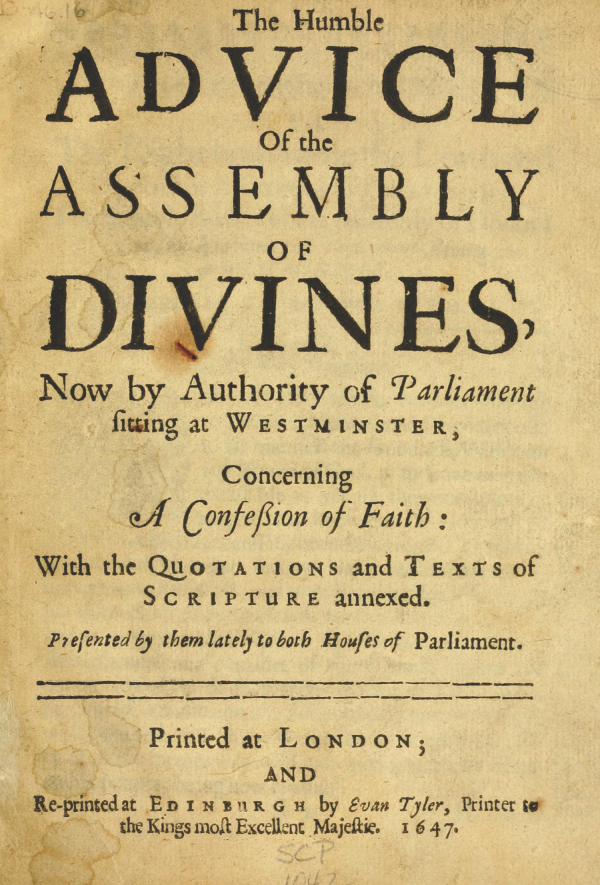 |
The Westminster Confession of faith 1646 |
The political origin: During the English Civil War (1642–1649), the English Parliament raised armies in an alliance with the de facto government of Scotland, against the forces of Charles I, who it was feared would return England, Scotland and Ireland to Catholic rule. The purpose of the Westminster Assembly, in which 121 Puritan clergymen participated, was to provide official documents for the reformation of the Church of England. The Church of Scotland had recently overthrown the bishops imposed by the King and reinstated Presbyterianism. For this reason, as a condition for entering into the alliance with the English Parliament, the Scottish Parliament required the return to reformed standards of doctrine and worship. The Confession and Catechisms were produced in order to secure the help of the Scots against the king. The theological content: The confession is a systematic exposition of Calvinist theology, influenced by Puritan theology. It includes doctrines common to most of Christianity such as the Trinity and Jesus' sacrificial death and resurrection, and it contains doctrines specific to Protestantism such as sola scriptura and sola fide. |
 |