
How Pelagius (354-418)
Relates to
the
Heresy of
Decisional Regeneration
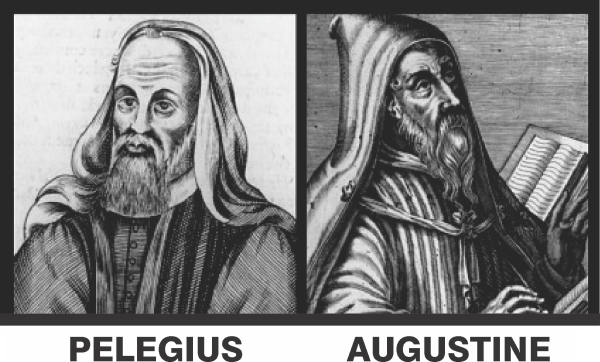 |
Pelegius was a monk who denied the doctrine of Original Sin and the need of the supernatural, immediate activity of the Holy Spirit in salvation. Just as Arminianism is often defined by the Calvinist rebuttal in TULIP, so Pelagianism is often defined by Augustine's rebuttal to it in the 9 beliefs of the Church defined at the Council of Carthage.
|
The two red items were denied starting with third generation New Light Calvinists, including the Hopkinisians Lyman Beecher and Asahel Nettleton. |
Pelagius denied the doctrine of original sin and the need of supernatural regeneration and the indwelling of the Holy Spirit for salvation to take place. The Scottish Common Sense Realism view of salvation maintains the doctrine of original sin, but denies the need of the immediate activity of the Holy Spirit it regeneration. By the time Charles Hodge took over Princeton theological Seminary, Calvinist salvation was seen as a purely psychological phenomenon. Freedom on the will consisted in the fact that a man's volitions are truly and properly his own, determined by nothing out of himself, but proceeding from his own views, feelings, and innermost dispositions, so that they are the real, intelligent, and conscious expression of his character, or of what is in his mind. Later, Princeton’s Dr. James McCosh (1811-1894), wrote "that the principle of cause and effect reigns in mind as in matter. But there is an important difference between the manner in which this principle operates in body and in spirit. In all proper mental operations the causes and the effects lie both within the mind. Mind is selfacting substance. We hold that the true determining cause of every given volition is not any mere anterior incitement, but the very soul itself by its inherent power of will." There's an important difference between this theory and the theory of Pelagius. Pelagius believed that man’s spirit was not the same as his mind. Scottish Common Sense Realists equated man’s spirit with the higher rational mind. Pelagius saw man’s spirit as pure from birth, able to help the mind overcome sin. Scottish Common Sense Realism, because it came forth from Western Christian theology, saw the spirit of man as part of the mind. Both Pelagius and Scottish Common Sense Realism abandoned the Biblical view that the immediate activity of the Holy Spirit was needed to change the mind….Pelagius relied on the spirit of man to change the mind and Scottish Common Sense Realism relied on the higher rational mind quickened by “truth impressions” to change the mind. “Truth impressions” are not identifiable except in their effect. “Truth impressions” are the de facto “grace” of Scottish Common Sense Realism that gradually changes the mind to the point it is convinced to begin serving God over self. McCosh summed up the reason for abandoning the Biblical view of the immediate activity of the Holy Spirit this way: “So far as our investigation pushes out into the world of nature, we find that law and order exist, and every increase of knowledge reveals to us further illustrations of the assertion that "order is Heaven's first law." Belief in the supernatural does not, therefore, require us to believe in any violation of law, since all reasoning which starts from what we know leads to the conclusion that "supernatural phenomena are as much the result of law as phenomena which are called 'natural.'" It's instructive to note that McCosh also believed evolution was the mechanism of God's creation...this is entirely consistent with Scottish Common Sense Realism's view of salvation as not requiring the immediate activity of the Holy Spirit. The immediate activity of the Holy Spirit could never conform to the new theory of truth being empirical. Scottish Common Sense Realism went with the new theory and abandoned the Biblical view of regeneration being a supernatural change of nature and the indwelling of the Holy Spirit.
|
 |